Friday, November 4, 2016

Overprepared

I may have been a little pessimistic about night-training kidlet.  To be fair, the past two years has been rather hellish in the potty department:  kidlet learned to pee in the potty relatively quickly, though perfecting the timing took a while.  But for some reason he was terrified of pooping in the toilet. And nothing, not ice cream, not promises of new toy cars, not even a promised visit to his cousins, could convince him to poop in the toilet.  For more than a year, the situation was that he was okay for the day, but literally five minutes after we put him in a diaper (for bed) he'd poop in it.

Well, the pooping-in-the-toilet issue resolved itself in a most spectacular fashion a few weeks ago.  It would be difficult to convey the degree of sturm und drang that happened that afternoon, but suffice it to say that more than one of us was in tears before it was over.  But it happened - and he began using the toilets for both numbers one and two after that, quite willingly, so I suppose the overall experience didn't scar him for life.

After that I waited a few weeks before starting night-training; it made sense to wait a while before making more drama with respect to wet beds.  Plus I needed some time to gather the supplies: extra el-cheapo sheets (thanks, IKEA!), and plastic mattress protectors to lay down underneath the sheets.  I bought 105 puppy pads - at 20 cents apiece, it was a steal over the 1.07 euros that the Jumbo charges for the exact same thing.  I was going to be Prepared, damn it - I had his bed made up in 3 layers (sheet, puppy pads, sheet, puppy pads, sheet, puppy pads), totally ready for the moment he'd wake up crying that his bed was wet and I'd just strip off the sheets, change his pants, and tuck him right back in.  I'd been reminding him that he needed to start waking up to go to the bathroom for weeks.  I even put off doing the whites in case he wet the bed the first few nights.

And what happened?  Exactly nothing. He went to bed, in underwear and pajamas, and then woke up the next morning as happy and cheerful as ever.  Not a drop of pee in the bed.

It's been that way for two days, now. I may need to find something else to do with 99 puppy pads....

Monday, June 6, 2016

Mobile working setup

So it goes without saying that I write anywhere I can, whenever I can find a spare minute.  In my case, that's recently expanded when I bought a tablet a few months ago.  At first it was mostly for fun, as I slowly acquired the apps I needed for maximum productivity  Now, I've got it configured to work almost--almost seamlessly with my desktop setup.

See, most of the time if I want to do any writing outside of the apartment that means packing up my laptop.  Which isn't so bad if kidlet's in peuterspeelzaal for a few hours and I'm chilling at Starbucks (yes, Nijmegen has one).  But having to lug a laptop around the playground with me so that I can make sure that kidlet's not being an insufferable twit as he hops-skips-jumps from one thing to another is a lot less convenient.

Enter the tablet: it's a small one, with a 7-inch screen.  I'd debated getting a bigger one but in the end decided that portability was what mattered more to me--after all, what's the point of getting a tablet if you're just going to sit at home?  If you're going to stay home and surf the web and all, then that's what the Chromebook is for (these days my husband uses it more often than I do).  Also, because it's tiny, it has the added advantage of me being able to type on an intact QWERTY keyboard with my thumbs, and thanks to Google's ever-smarter autocorrect feature, it even manages to make my life a little easier.

My setup is still a bit of a mess; in a perfect world Scrivener would come out with a mobile app for Android and I would be able save my stuff in Google Drive and access it wherever I have WiFi.  But mostly, what I do is this:

1) Export, out of Scrivener, the current chapter I'm working on as an *.rtf file (the file type is largely irrelevant at this point for me, but I find that RTF files open faster), into OneDrive.
2) In my tablet, download the file off of OneDrive onto the tablet's internal memory. This step isn't strictly necessary, but I've found that sometimes places that are said to offer free WiFi, don't, and sometimes when they do, it doesn't work. Granted, Android systems are notorious for not always getting connected and/or staying connected to WiFi systems. But the point is, it's a precaution.
3) Go to place
4) Open the file using OfficeSuite.  I suppose at some point I might actually download Word and all those other Office apps, but at this point OfficeSuite does a good job and one word processor is the same as any other.
5) Write. Save.
6) Come home (or if the WiFi is actually working as promised...)
7) Move the file back to OneDrive.
8) Open my laptop.  In Scrivener, import the file and replace the one that was there.

I know, I know, it's clunky and horrible, but this comes about mostly because a) Scrivener files can only be opened in Scrivener and b) there is no app that can open Scrivener files.  If I worked in Word it would be a lot easier to streamline. Right now, though, the advantages of working in Scrivener outweigh the disadvantages faced when I need to go mobile.


Thursday, May 19, 2016

Walking the Line


Every parent wants to believe their kids are talented in some way, and I am no exception. Part of the process of growing up and away, after all is finding out new things about yourself and your kids.  

But there's a difference between actively encouraging your kid to develop his own interests (good) and pushing them to succeed because you've got issues (bad). What that difference actually is, in practice, though, is turning out to be rather difficult to discern in real life. 

Kidlet has always been a motorhead, a gear monkey, a car nut--you get the picture. If there's a motor on it, he'll love it. He loves watching the lawnmower--the lawnmower--as it does laps around our building, cutting the grass.  He could quite literally sit at a construction site for hours if there's an excavator and a bulldozer.  I harbor a secret fantasy of bringing him to Schipol and relaxing for three hours while he watches planes.

But his real love is driving.  

He got a push-car for Christmas two years ago and he's still coasting with that damn car all over the apartment.  Ever since he discovered the battery-powered cars at the Brakkefort I've been shelling out for the god-damned tokens so that he can get a drive (now up to two) in each time we go.  And pedal-carts--if it weren't for the fact that we go mostly at the non-peak times, there would be a lot more screeching kiddos at these places.  And he is...surprisingly good at it, able to wrestle huge steel contraptions that weigh more than I do  through hairpin turns and s-curves like I'd pushed one of those suckers out with him.  

It's easy to see where this is heading: dreams of Formula-1 glory, like Max Verstappen, the kid who's just won one of the Grand Prix's in Spain.  Of course, I know this is a long shot, at best. And odds are he'll never get past just a few turns on the go-kart track for fun when he's fourteen. I would be okay with that--and that's what makes walking the line between letting him drive as much as he can and making too much of it so damn hard.  I mean, what is "too much" for a kidlet? I mean, if he likes it, what's the harm, right? And isn't the whole point of parenting teaching a kid to get up again when he falls down? Where's the line between encouraging a kid and pushing them?

Monday, March 21, 2016

Buses and Cars and Trains, Oh My!

Kidlet has always been a good traveler.  I feel like I have to start this post with that because everything that I'm going to write afterward depends on keeping that in mind.  Whether it's an afternoon or a morning in town, or a weeklong jaunt to Luxumbourg, he's never had a (much of) a problem sleeping in different situations and he simply loves riding in buses, trains, and cars.  And I've never been the kind of mom to carry around a ton of extra diapers, an extra outfit, twenty snacks, three packages of wipes, and enough toys to fill a daycare--what can I say, I'm lazy.

Laziness is also the driving reason why I'm an absolute minimalist when it comes to packing kidlet's things for trips.  This is all I'm bringing with us for a 5-day trip to Maastricht:  it includes clothes for me, clothes for him, all of our toiletries, snacks for the train (it's a two-hour ride), toys for a week, a grocery bag, diapers for night-time and emergencies, my planners, and my electronics (my laptop, tablet, phone, chargers).  


There's nothing must-have about my travel things.  I don't use packing cubes or anything like that, I don't have special games or toys, and I won't even have a stroller with me. A few things that I do to cut back on the bulk:
  • I don't use separate kids' and adult shampoos and body washes.  Really, it doesn't make a difference, and the ingredients are exactly the same, except for the coloring and perfumes used.  So if he smells like coconut-cream instead of little stinky Minion (I did get him a Minion body wash, but that was only because the bottle was a Minion), well, it's not as if anybody else is going to get close enough to tell.  And anyway, as long as you rinse them off well, you don't have to worry about irritation.  
  • I make him carry his own damn toys and snacks.  This week was a bit of an exception, because we'll be gone for a week and the apartment that I'm using doesn't have stuff for kids. But even so, between the stuff in his little red backpack and the smaller compartment of mine (it's an LL Bean backpack, and yes, the brand really does last for-f*cking-ever), he's got enough to keep him busy for a week.  
  • For my end:  I wear skirts-and-legging outfits.  Leggings are compact.  Skirts don't get too dirty.  So all I really need is enough tops, and even there, I use one jacket and just change the t-shirt underneath. I'm wearing my jeans today and on our way back.  
  • I haven't used a stroller since kidlet turned 2.  Seriously.  Yes, it's a bit of a pain to get him to go when he's tired.  But it means he'll fall asleep without issues in the evening, and it saves me a headache from having to lug a stroller everywhere.  Win-win-lose is still winning, overall.  
  • I've made plans to rent a bike with a kiddie seat on the back when we get there.  Seriously, if you're ever in a Dutch city and you have a toddler, forget the stroller, just rent a bike.  Well, unless you're in Amsterdam--riding a bike there is just a death wish.  But Maastricht is so nice to bike in, and renting a bike will save you a small fortune in transit fees.  
But really, the most important thing isn't a thing:  it's confidence that you know your kid and what they can handle.  It's being able to accept that sh*t happens to the best-laid plans.  It's treating a long trip like an adventure that it is rather than something to be endured.

Thursday, February 4, 2016

Decisions, decisions

One of the most nerve-wracking and head-achey decisions you have to make as a parent in the Netherlands is which basisschool to send your kid to.  First of all, it doesn't help that they start during the academic year during which your kid turns 4, so for a November baby like kidlet that means he gets to start at the ripe old age of 3.  Secondly, it turns out that there are at least 4 different teaching principles that different schools can follow, so there actually is a big difference between the schools and therefore the only way you can tell which school has what available is to go see the school itself.  Most schools have an opendag, where parents can come in for a quick talk about the education principles of the school (Jenaplan, for instance, or Brede plan) and take a tour of the facilities.  So that's what I've been busy with this past month, visiting every school nearby and taking in the pros and cons of the places.

In Nijmegen, at least, you're allowed to pick six basisscholen, ranked in order of preference.  You fill out the form online, and then in a few weeks or months you get a letter in the mail telling you which school you can send your kid to. And the problem, at least from a "which school is better" standpoint, is that all Dutch schools have to guarantee that your kid will become literate and know how to add and subtract, at least.  One school is not "better" than the other, educationally-speaking.  This actually sets a lot of worries about picking the "right" school away and lets you focus on picking, well, the right school.

The part that makes this such a headache is that there are a lot of schools.  In our area (meaning within a 3-mile radius) there are at least 8 schools we could theoretically send kidlet to. Some of them are much farther away than others, and obviously distance factors into the decision quite a bit.  Most of them are ordinary schools, meaning that they follow a standard curriculum, but some of them follow the Jenaplan system and there are a few Montessori schools as well.  So it really does depend on what you think is best for your kid.

Things that I've discovered about myself:  diversity matters a lot more to me than I thought it did.  I mean, I don't mind kidlet attending the peuterspeelzaal where literally every child is some shade of blonde except kidlet.  It's a good peuterspeelzaal and the teachers are patient and kind, and kidlet's Dutch is improving in leaps and bounds, but he's still not speaking Dutch 100% yet and it's getting down to the wire as to whether or not he needs logopedie (speech therapy). But the proportion of blonde versus non-blonde kids is highly indicative (at least so far, in my experience) of whether the school has experience dealing with bilingual kids.   I would mind a lot less about the lack of diversity in some schools that I've visited if they were able to give me a shred of confidence that they had the experience of dealing with bilingual kids, but one of them just point-blank told me, "We don't have any facilities or experience with that."

And, well, frankly--there is something to be said about attending a school with kids from all kinds of backgrounds. I mean, okay, I get that this is the Netherlands, that most people are white and and tall and blonde.  But a lot of the issues and microaggressions and finer points of not-being-racist would be greatly mitigated if people grew up in a diverse environment, I think.

Friday, January 8, 2016

There's this prevalent notion floating about on the Internet that we are in a "post-racial" era.  That declaring,"I'm colorblind! I don't even notice race!" is the same thing as saying, "There's no such thing as racism!"

Except a) we're not in a post-racial world, and b) if you truly "don't notice" race, then you're either deaf, dumb, and blind, or an idiot, because everybody notices if the person they're talking to is different.  Especially if the answer she gives to the question, "So where are you from?" is not what they expect it to be.

Granted, racism these days is not expressed by burning crosses and telling black people to GTFO of wherever it is they're "not supposed" to be.  Not usually, anyway.  And in Europe, it's conflated (especially now) with religious animosity against Muslims, and in the Netherlands, the yearly Zwarte Piet debacle.  I'm not going to offer any solutions; as an expat, my understanding of local politics is limited to "Well, that's dumb" and swearing at the IND every time they demand that I cough up 228 euros for an ID card that's apparently no longer valid once you get a Dutch passport.

But I can tell you what racism looks like, since a lot of people don't seem to realize that they are committing these "microaggressions" when they're "just making small talk." And honestly, I know that they're trying to be friendly, but unlike most Chinese people in Europe (I would imagine--I haven't met that many) I actually possess the vocabulary to spell out exactly what's so wrong about and why it's so horrible.

I'll give you 2 examples:

  1. Karel's friend is really big into traditional Chinese medicine and yoga and Eastern medicine.  Whatever. That's his thing. If he wants to talk a blue streak about it, well, I'm cool with that. I'm not a believer--and frankly, acupuncture is just creepy to me. And he said, "I never thought I'd have to argue for TCM with someone from China." Which is just irritating, even without taking into account that he knows me well enough to know that I grew up in the US, attended a medical school, worked in biology, and don't cook Chinese food and instead make a mean stamppot
  2. I was at the printer's, getting something printed out in preparation for a client meeting, and the guy who's helping me...actually doesn't start up with the whole "So where are you from?" line of questioning.  Nope, instead he seems surprised that kidlet speaks a mix of Dutch and English, and asks me what other languages I speak.  I tell him that we speak Dutch and English to him.  And then he asks me what my mother tongue is.  I tell him it's English (because it is). And then he asks me if I speak Chinese to kidlet.  And then he makes a comment about kidlet's big eyes, somehow completely missing the fact that kidlet's hair is definitely brown, not black, and assuming that he's Asian rather than a halfie.  (I mean, okay, kidlet definitely takes after me in terms of facial features, but how do you miss the fact that his hair is brown?  Especially when I'm right next to him for comparison? I know I'm going gray but I swear it's not that bad yet).
Do these incidents mark the end of the world? No. But here's the thing that white people don't get:  we can't talk about racism without dealing with all of the subconscious baggage that you guys have about what someone is "supposed" to be like.  And that's the thing with subconscious baggage--you can swear on your life, and even believe, that you don't see color/race, but subconsciously, things register, and slowly but surely they color the lens through which you perceive the world. And you can swear on your life that you don't hate [race] people, but hate isn't the problem. It's the thousand invisible things that you guys do that grate on our nerves, but woe be the one who says anything about it, lest she appear "too sensitive". 

But every time you do one of those things, you're feeding a machine that tells people that they are limited by the color of their skin and their ancestry, telling people like me that being born somewhere determines who I am rather than the effort I've put into making something of myself.  You're telling me that you're only interested in my story if it fits your preconceived ideas of what an Asian person is doing living in the Netherlands. You're telling me that you, whom I've just met at the bus stop and am making idle talk to while we wait, know me better than I, who spent 34 years living my life and working out all the shit in my life, do. And maybe I'm presuming--but at least I'm aware that I'm doing so--but I do think that you'd be fucking pissed if I were to do the same to you.

And yet, every time this happens, I feel bad for the person I'm talking to.  I feel like it's my job not to let them down, or at least do so gently. I mean, I get it--they don't mean to be nasty, not like the jackholes who scream, "Konichiwa" at me as they ride by on their bikes (would that eye rolls be translated into bowling balls). And being polite has always been second-nature to me.  But still--why should I have to be the only one swallowing my discomfort just so the person I'm talking to--the one who started this--doesn't have to feel bad?  

Answer: because nobody wants to be "the supersensitive" wilting flower that can't take a comment the right way. Even if it's the one making the comment who could do better.  

Monday, January 4, 2016

Yes, he's allowed to say that

As long as we're dredging up my list of parenting fails, there's this:  

Kidlet tells me, "I don't like you," at least once a day.  Sometimes many times a day.  And you know what?  I'm cool with it.

Because, if we're going to be honest, I tell him that, too.  Not quite as often, and usually when he's in the preliminary phases of pitching a fit, those moments after me putting my foot down about something but before he's totally lost control.  Because, in those moments, I don't like him.  He's yelling, getting worked up--it's a 50/50 chance whether he's able to listen.  If he is, then he can usually be talked down.  If he isn't, then it's a toddler-drama-rama all around.

Here's the thing, though:  I don't tell him, "If you do this then I'll like you again." I do tell him that I love him, frequently and on a whim.  He'll eventually work out that liking someone isn't the same as loving someone, and that just because you love someone doesn't mean they can't annoy the bejesus out of you once in a while.  

And I like to think that he's going to internalize that it's OK not to be liked.  When he tells me, "I don't like you," I tell him, "You don't have to like me.  You have to pick up your cars," or whatever it is that I asked him to do that prompts the declaration of not-liking mommy.  That it's OK to stick to your guns even if people don't like you.  That it's OK to tell people that they're being jerks.  

He doesn't have to like me when I tell him to pick up his trucks, and he doesn't have to like me when I tell him it's time for bed.  He's free to express his discontent verbally, which I think goes a long way towards not having it expressed in a screaming fit.  Because honestly, who in their right minds likes to be told where to go, what to do, what to wear, when to potty, how to do things, to keep quiet, not to yell, etc. all day?  So yeah.  He's allowed to not like me. 

Because when he comes to our bed at an ungodly hour of the morning; when he snuggles between us with a contented little sigh as he waits for me to get up; these and a thousand little things through all the days is love.  He loves us, we love him. Plain and simple.  That's always true, all the time.  Even if we don't like each other much at that moment.  

Sunday, January 3, 2016

I Give Zero F*cks


There's always a lot of talk about regulating screen time, how you shouldn't let your kid stew in front of the TV all day and so on and so forth.  And I agree with that, for the most part: watching TV all day every day is a terrible waste of time.  But playing with a tablet?  That's a little more nuanced.  Most people agree that it's impossible to keep a kid away from them, and that a strategic retreat is needed:  they set limits (30 minutes) or take them away for not doing chores or what-not.

Me?  I give zero f*cks about whether kidlet wants to spend his entire day playing with the damn iPad.  And here's why: I trust him to be smart enough to know when he's bored.  My only rules are:  1) no screens when eating (this is a family-wide thing, and it applies to Karel as well) and 2) no crying or whining when I tell him to put it away (i.e., when we need to go out, or when it's time for dinner).  If he does, then he loses the iPad for the rest of he day and the entire day thereafter.  It's a simple system that doesn't involve timers or some arbitrary limit.  And it works.  Yes, there were a few fits the first few days when he got his own iPad with new games, but after he worked out the rules for himself he's been pretty good about it and I don't have to fight with him to put it down.

I'm sure someone out there is having a heart attack reading this right now.  But here's the thing: after the first few days, when he spent close to 4 hours watching YouTube movies and playing with his apps, his using the iPad dropped, the same way it did with my phone. And now he spends maybe 30 minutes a day playing with the thing before he decides to pull out his cars or rediscover his "microbots" (hematite stones carved in a shape that resembled the microbots seen in Big Hero 6).  Or he'll ask us to fill the bathroom sink so that he can play with the water.  Or he'll get his crayons out of the closet.  Or ask me to take him to the playground.  Or...well, you get the idea: kid stuff.

Kids aren't stupid, and they'll work out when they've had enough.  Of course a new tablet, filled with fun apps, is going to absorb all of their attention, but it won't last.  It can't last--they just don't have the attention span or the ability to sit still that long.  It may take a little longer before they figure out their own limits, but there is a life beyond a tablet.  And of course you can use time with the tablet as a carrot as opposed to a stick, or set a time limit. But that doesn't teach them their own personal limits--it reinforces the idea that good things are scarce in this world so they need to have all the good things, all at once. And I know Freud has long since been discounted as a quack, but you have to wonder whether the (uniquely American) inability to moderate has something to do with this.

I wonder when we stopped listening to kids telling us what they want/need.  I mean, sure, they don't always know what's best for them, so it's up to us to make suggestions and make sure they know the rules.  But discipline isn't about teaching kids blind obedience to authority; it's about providing them with an appropriate frame in which to live their own lives. And that's the key, the "living their own lives" part, that I want for my kid.  It's not his job to make me happy.  His job is to grow up, my job is to give him what he needs to do that.  And part of that is really listening to him, accepting that sometimes that means pears and olives for breakfast instead of oatmeal, or taking him to the HEMA for a lunch date, just because.

I'm an atheist, but I do have faith:  that kidlet knows himself, and that as long as we continue to provide him with a bedrock of unconditional love and mutual respect, he'll turn out all right.  I wonder when people lost this faith--and what it will take for them to find it again. 

Friday, November 27, 2015

Hello Fresh!

I'm the penny pinching one in this household. Kidlet doesn't know what a penny is, yet, and Karel...well, I love the guy but tracking spending is not his forte.  Suffice it to say, then, that when Hello Fresh debuted in the Netherlands two years ago I laughed and told the guys selling subscriptions to fuck off.  

This is because they charge €39.99 for a box of 3 meals for 2 people.  That's €13.33 per meal, €6.66 per serving, folks. And they don't even come over and do the dishes for you. For someone who typically drives down the cost of dinner to €2-3 per person, it's ridiculous.  

But if I were to be completely honest...I can't deny that I wasn't tempted. Setting asid
e time every day to go grocery shopping is a bit of a drag, and that goes double if Karel isn't home to babysit kidlet while I run out for a carton of milk. 

These sort of subscription-boxes have been popular on both sides of the Atlantic for a while, now: they're supposed to simplify your life (or at the very least, your grocery shopping) while providing a good, homemade meal for the cost of a Value Meal at McDonald's (yeah...the Value Meals where I live...aren't, exactly).  You get all the ingredients you need, pre-measured in the quantities for however many people you're cooking for (minus a few basics, like olive oil, flour, milk) and then you just follow the directions on the menu card.  In their perfect world, you'd get a box every week, but forty euros a week for 3 dinners is obscene by any standard except Parisians'.  Fortunately it's easy to log onto the website and tell them when you want a box delivered, and with Hello Fresh, you're only obligated to buy two boxes at full price.

The good news is that Hello Fresh, at least, has really big portions, which works out well because we're two adults and one hungry kidlet.  The four measly potatoes you get for a stamppot might not look like much, but add a package of saurkraut and a couple of sausages and you've got an all-out meal.  There are vegetarian options as well, and they're tasty, too.

The bad news is that you kinda-sorta-hafta know how to cook first before you can make anything really tasty with it. For our box last week, we had mackerel wraps, saurkraut stamppot, and a vegetarian lasagna.  None of these required any special skills to make, but I can imagine that, if you're not used to cooking it would be kind of daunting, especially when it comes to making a roux for the cheese sauce with the lasagna, or some of the fancier cooking things that are required of you.  You don't  need a lot of kitchen utensils, and the ones that are recommended are the sort of things that most people would have. But then again, there was a time when we didn't have a baking sheet.  That being said, the recipes do taste something splendid--it says a lot when a three-year-old will eat eggplant and spinach without whining. 

I'm still kind of divided on whether it's good value; I feel like if they'd drop the price to 30 or even 35 euros I'd probably get the boxes a lot more often.  I mean, things like fresh pasta and smoked mackerel aren't exactly cheap at the supermarket, either, and after the peace of mind afforded by three days of only having to shop for things like milk and cat food, I can definitely see the value in having someone else do the thinking for you.

Wednesday, November 11, 2015

Getting help

It's no secret that kidlet is weird--the kid is great on long trips, for example, goes to bed without a problem most nights, loves olives and sunny-side-up eggs (but won't touch hard-boiled ones). But there's weird, and then there's worrying, and kidlet's particular brand of weirdness has had us mildly worried for a while. But it wasn't until I discovered that I'd have to register him for basischool next year that we decided to take the leap and have him independently assessed. Sending him to school next year when he's still using nonsense-words (in either language) just won't do.

And this is where the consultatiebureau really morphs from something merely very annoying to something that is a godsend, because all it took was one phone call, explaining what we've been observing, and someone came to our place, agreed that further assessments were needed, and an observer was placed in kidlet's peuterspeelzaal class to see if we were merely being overly-worried parents.

The observer, a licensed child development specialist, assured us that some of our worries would resolve themselves eventually, but some of our worries were justifiable ones and that it was a good thing that we'd called them. Early intervention can work wonders, but only if parents recognize that something is wrong, and  sometimes what's taken for granted as "of course it takes longer" can cross the line into an actual developmental delay, and the things that we should be worried about, according to the specialist, were straddling that line.

I'll admit, when I first had him, it was a PITA dragging a kidlet all the way to the consultatiebureau every month--even though we had a car by that point Karel was away more often than not, and I didn't get a bike again until last year, so that meant I either had to walk 40 minutes, or take a bus, beginning and ending my trip with a 15-minute walk. Suffice it to say that, while I was always glad for a healthy-baby report, it didn't always alleviate the peevishness from schlepping a kidlet around for almost an hour, just for people to tell me that everything was normal.  But they've been nothing but wonderful for us, outlining a plan of monitoring and interventions for the next six months that seems like a cross between .

For now, not much will change: kidlet will start seeing a speech therapist at the very least, and if there is space for him we'll increase his peuterspeelzaal time to three mornings a week. There was a recommendation that he attends a peutergym to allow him to move around in the ways that he seems to want to, and improve his kinesthetic awareness.  Hopefully this will be enough. 

Wednesday, October 28, 2015

Paris! With an almost-3-year-old...

Paris!  What can I say? Despite being underwhelmed by it the last time I visited (though that was due largely to the fact that I was out €200 before I even got there and therefore could barely afford to eat) when I found out that Karel had never seen Paris properly, I was horrified and therefore decided that, rather than have an anniversary dinner in the quiet comfort of a gourmet restaurant appended to a hotel with kidlet being baby-sat by his aunt and uncle and cousins, we would drag a 3-year-old on a 5-hour train ride through a smog-ridden city and eat cheap food and walk until kidlet keeled over with exhaustion.

So you might be thinking that this might be a horror story about navigating Paris with a 3-year-old.  But actually, well, kidlet was very well-behaved the entire time.  When our train was stuck in Roosendal for over an hour, and then we had to take the slow train to Antwerp, there was only a minimum of fussing.  Then from Antwerp, we had to go to Brussels, which was another long slog and it was almost 3 pm by the time we were able to explain to someone at the Thalys (French high-speed rail company) what had happened and what we were trying to do.  It was slightly complicated due to the fact that I used e-tickets on my phone because printing stuff involved a headache-and-a-half (drivers for the printer not up-to-date with Windows 10, etc), and the Thalys service counter in Brussels Central for some reason couldn't look up the ticket information even though it was right on my phone, so our only recourse was to go to the main Thalys desk in Brussels-Midi.  Fortunately, news of the snafu at Roosendal had been sent down the pipeline well in advance, so one quick explanation to the people working the desk and we got a piece of paper and permission to board the next train to Paris.  And we were lucky to run into a sympathetic conductor--maybe it was just because we had kidlet with us--who was able to find seats for us in the first-class compartment, so that was nice.  So basically, by the time we arrived at our hotel we'd been on the road for 10 hours straight and it was a relief for all of us to crash and sleep, pretty much right away.

The next morning I'd planned on taking Karel and kidlet to the Eiffel tower and Notre Dame.  It was a beautiful day and kidlet got up at 6 am because he's kidlet and he always, come hell or high water, gets up at least an hour too early.  Karel had paid for breakfast at the hotel (ibis), so it was convenient and made more sense than wandering through the streets of Paris trying to find a place that doesn't charge €10 for a croissant, orange juice, and coffee.  I mean, yeah, the breakfast at the Hotel ibis was €10.50 but at least you had choices (croissant, madelines, pain au chocolate, fruit, yogurt, cheese, cold cuts, eggs) and decent coffee.

The Eiffel tower and Notre Dame were amusing just because they were sights you have to see for yourself, but I have to agree with Karel that the best part of the day wasn't the sights, it was walking through the streets, meandering along and looking at things that caught our fancy: a bag of dried lavender buds, for instance.  We were able to bribe kidlet into going quietly into Notre Dame with the promise of ice cream that we'd seen on our way there.  It was getting to see the sketchy parts of Paris and cramming ourselves into the Metro along with all of the other commuters.

The next day we wandered slowly through Montmarte, the neighborhood our hotel was in. Our destination was the Basilica du Sacre Coeur but we had five hours to find it before we needed to get our bags from the hotel, so we were in no rush.  It wasn't as if it was hard to miss, either--the church sits at the top of an enormous hill, flanked by gardens. We went up the hill the hard way--on foot, yes, even kidlet, who seemed more determined than ever to reach the top--but there were tram cars ferrying passengers up and down the hill. Entrance to the basilica is free (always a perk) but you had to pay €6 for the privilege of climbing 300 stairs to the dome--which, to my mind, was definitely worth it for the view, though on the day we went it was drizzling a bit and the rain had turned the marble as slick as ice, so going down--especially since kidlet still has the outsized head of most toddlers--was a challenge, to say the least.

Food was still shockingly overpriced.  Granted, the portions were probably a little bigger than they are in the Netherlands, but still:  €12.50 for a grilled-cheese sandwich is outrageous.  If it'd been me and Karel alone, no doubt we'd do a lot more walking to find places to eat that are off the beaten path--food tends to be cheaper the farther away it is from tourists--but kidlet, tough though he may be, can only trek so far. But the indifference and bad service that people always seem to complain about when they visit Paris wasn't really an issue for us.  Contrary to perceived wisdom, I think we actually got better service because we had kidlet.  I mean, people actually gave up their seats on the Metro when we got in.  And then the proprietor of a cafe we stopped at for coffee gave kidlet one of those Eiffel Tower miniatures that they sell on the streets, and two free cookies. The Rough Guide was right about Parisians loving children--though I think part of it was also that we weren't trying to wrestle a huge Quinny stroller into the rush-hour Metro.

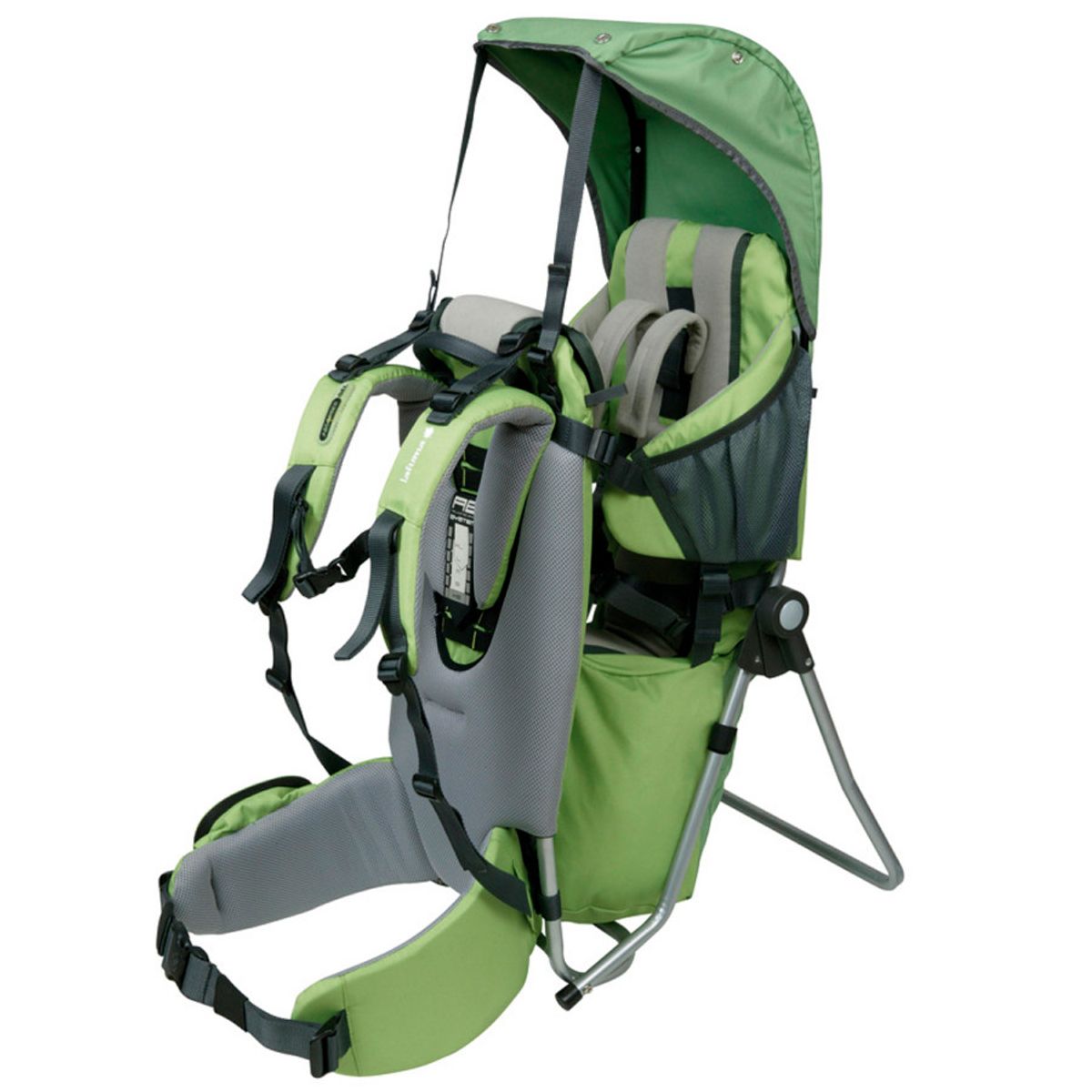
We opted to bring what we called the kiddie-backpack, one of those child carriers people typically use for hiking, instead of the stroller (the one pictured here is not ours--it's just an example of the type of heavy-duty child carrier we have). Part of this was because Parisian streets are not nice to strollers--there are cobblestones and potholes, and some of them are very narrow and most of them are crowded.  Part of  this was because tucking a Quinny into the baggage compartment on the Thalys is nigh-impossible.  And it turned out that, in Montmarte, the hills are so steep that stairs are used rather than normal methods of paving them, so a stroller would have been nearly useless anyway.  Not to mention that there's no place to park strollers if you want to go inside places like the basilica or Notre Dame, and that if you're going to a cafe it's a lot easier to squeeze between tables if you're not pushing a stroller around.  We took it with us everywhere we went, even though kidlet spent most of the time running around--empty, it's bulky but lightweight, so it wasn't too much of a burden and it was nice to have for the times when kidlet couldn't go on any more.

Suffice it to say that Paris was fantastic.  It's true, what they say about doing things with people you love.  And passing on the sense of adventure to kidlet--well, what could be better?

Friday, October 23, 2015

What is Discipline?


It always irritates me a little when people brag about how, when they were little, they got smacked around and came out all right in the end.  It bugs me when people admit to spanking their kids--don't get me wrong, now that kidlet's almost 3 I experience the urge to smack him a good one at least once a day, so I totally understand the sensation of being powerless over a kid's obstinate "no".  And it really, really pisses me off to see some parent punishing their child and read comments lauding that parent for "good discipline".

Let's get something straight, here:  good discipline is not punishing a child when they do something wrong (more on this later).  Good discipline is structuring your life so that your child learns how to live.  Good discipline is not merely not-giving your child a biscuit every time they ask for one; good discipline is telling your kid what you expect of them before you go into the store and then giving them a hug when they do it.  Discipline, after all, means "to teach"; it means teaching them to get up when they fall, to try again if they fail, that you--and by extension the world--have certain expectations of them that they have to meet in order to become members of society; that they can't always get their way and that crying about it won't solve problems.  Good discipline, in other words, is a way of life, a mindset that you either embrace, or not.  If you don't live a disciplined life, then no amount of time-outs or spanking will ever give you a disciplined child.

Punishing a child is something in the framework of good discipline, but it is not the end-all-be-all of discipline.  It is something that needs to happen, occasionally, to teach a kid what not to do, but if you're disciplining your child then they'll have already figured out what they should be doing.  You can't punish a child into good behavior.  Bad behavior needs to have consequences, of course--but only insofar as it teaches the child what not to do. Teaching a child how to behave is not the same thing as smacking them until they stop doing anything.  And spanking a child--well, like I said, I understand the urge to.  But I'm an adult.  I know better.

Which leads me to the other point:  respect is not the same thing as fear.  Respect goes two ways.  If you respect your child's person--if you respect their wishes, stop tickling them when they say so, and respect them the way you want to be respected--then odds are they will respect you.  This is not to say that you should bribe your child for good behavior, but just to say that children are people--or trying to be people--and the way to get respect is to give it.  You can't tell a child "no TV" all the time while playing World of Warcraft for three hours straight and then expect them to listen to you when you tell them to eat their dinner. You can't tell a child it's not okay to hit his brother while spanking him for doing it.

And this is not to say that your kids will end up brats if you do these things or not.  Kids are resilient and pick up a lot more than we give them credit for. As long as you're doing some kind of parenting, your kids will probably end up all right, despite everything you're doing or not-doing to screw them up.

Friday, October 9, 2015

Home improvement

I gotta say, it's amazing what a couple of screws and some white paint can do for a space.

We--or rather, Karel--has been on a bit of a home improvement kick recently.  It started with the little things, like (FINALLY) sectioning off the loose cords that we have running through the place, confining them with little runners and basically making the place safe for humanity and toddlers with giant heads. Then he mounted the TV to one of our walls, making it safe and freeing up a ton of extra space in our living room again.  I have a place to hang the drying racks on the (rare) occasions when they're not being used. We replaced out closet with the Algot system from IKEA. The ugly hole under our water heater (we have a tankless water heater) got plastered over, the gap in the concrete floor got filled, and a bookshelf--with a space for our stand mixer--got put up.  Karel built a custom drawer system in the space where our dishwasher had been, and now, over the past few days, he single-handedly emptied the pantry (except for the washer), painted the space, and put up a ton of new shelves. It's not quite finished yet--we'll be picking up a second Raskog cart from IKEA soon--but it's already a ton better than it was before. Still on the list of things to do is to build kidlet a lofted bed, build him a new bookshelf/desk system for his room, patch up the hole in the wall of kidlet's room, and install a bunch of new Algot shelves/baskets in our room to make better use of the space we have.  That, and painting EVERYTHING.

The goal is, ostensibly, to make the place sell-able.  Nijmegen is a lovely city but it's far away from Deventer and should Karel luck into finding a job elsewhere, we'll probably have to move, and the place will be much, much easier to sell if it looks neat.

But more than that, well--I think of all of these changes as being reflective of the state of things in our minds and marriage.  Before that--things were okay. We hung in there.  It wasn't great, but it was okay and it was what we were used to, and we didn't really make any plans to change it. It wasn't that we didn't have any plans (I had lots of  plans), it was just that all of the plans required at least a few days of concentrated effort and Karel, until recently, had always been an all-or-nothing kind of guy.

I won't go into what sparked this sudden transformation, but suffice it to say that home improvement isn't really just about home improvement as it is about life improvement.  Encoded in the now-brilliantly-efficient kitchen and our vastly more relaxed space is a lifestyle that's more effective, and therefore, more relaxed.  Neatness is built-in, rather than constantly-striven-for.  And we are truly happier than we've been with where we live for a long, long time.  

Thursday, September 10, 2015

BCC: Bullshit, we Can't Convey anything

The Dutch are infamous for terrible customer service.  Customer service, it is said, is rude (probably true, by American standards), can never help you in the way you want to be helped (likely to be true), and just generally makes a bad situation even worse (maybe this is true).

Somehow, though--maybe it's because I do most of my customer-service interactions when people are actually bright ad perky--I've managed to avoid getting too screwed over in terms of getting service. At the very least, (gemeente official business notwithstanding) I've come to terms with the fact that if I'm getting bottom-euro prices it's not because they've hired Service Sally to man the desk when it comes to complaints.

But even my luck runs out, and in our case, it was with BCC.  You'd think that a web retailer--and a major web retailer, at that--would have the ability to list merchandise that is out of stock as "niet in vooraad" instead of allowing you to pay for it and expect next-day delivery. And then, when you call them the next day, you find out (after a 2-hour wait on the phone, no less) that they are unable to give you any information on your order.  And when you reach out with Facebook, only then do you find out that it's out of stock and will take between 5-10 days to arrive.

And now, on the promised day of arrival (10 days yippee), lo and behold, the washer which was supposed to have been delivered this morning is nowhere in sight, and we just found out (via FB again, after over an hour on the phone and getting nowhere near customer service) that there was something wrong with the scheduling system and we'll have to wait for another 5 days.  I've been doing the laundry by hand for the past week (because the cleaners charges at least 27 euros each time) and it's just plain fucking nuts, especially since one of their services they claim to offer is next-day delivery.

Look:  I'm willing to accept a longer delivery time, but for fuck's sake don't dick your customers around like this.  Either say outright that it will take 5-7 days to deliver shit, or don't deliver shit at all.  And 'fess up to not having stuff in stock.  Yeah, maybe you might lose that sale, but two weeks without being able to do laundry is going to lose you a customer.  Several, if I have my way, and many, if there are truly that many pissed off people on their Facebook page.

Wednesday, September 2, 2015

Inheriting citizenship, part 2 of 2: why kidlet had a rap sheet before he turned 1

The consequences of a system that confers citizenship by blood rather than birth can be quite...well, I don't know if "amusing" is the right word, but in retrospect it definitely falls into the "you wouldn't believe it unless it happened to you".

What happened?

Well, in 2006 - well before we had kidlet, before I even arrived in the Netherlands - Karel went to Belgium for a year to work on a research project.  It was only a year, and since Belgium barely has a govenrment at all, he didn't bother to register a change-of-address (you can only have one official address) since he was going to be moving back to the Netherlands after the year was over.

Fast-forward 6 years:  I'm 8.5 months pregnant, living with Karel but not married to him (this is an important detail), and at my midwife's appointment the midwife asks me whether I've arranged for Karel to be recognized as Kidlet's father.  I stare at her like she just spouted another head.  She tells me that because we're not married, I have to grant Karel paternity, and that takes a little arranging through the gemeente.  "Just a few papers to sign," I'm told, nothing to worry about.

Because Karel is working essentially right up to my due date, and because I am too exhausted to lumber to town, though, we don't get this fixed right away.  But it's not a big deal, I'm told, because I can sign things at the hospital and over the next few weeks postpartum. So I have kidlet, more or less on schedule.  Because he came out of my body and because we're not married, he gets registered as an American, and Karel is assured that he can get it changed over the next few weeks.

Except:  remember the little research stint in 2006?  According to the city clerk we spoke with, before Karel could be recognized as the kidlet's dad, he first had to demonstrate that he wasn't married in Belgium.  Which is easier said than done, because if you never register your temporary residence then there is no way for the Belgian government to know that you were ever there, and not being able to provide proof of a non-event is (in Dutch circles) not the same as providing documentation that anything ever happened.

In the meantime, the Immigratie en Naturalisatsie Dienst received word that an unregistered American (irony, anybody?) had appeared at our address, and as this was highly improper, we got served with papers filled with scary-sounding-official-Dutch that told us to explain our case to the police department.  I call the IND, asking them what I need to do to get kidlet on the right side of Dutch law, and they tell me that if he has an American passport they can process him like any other American expat.

An American passport, though, is $200+ dollars that I didn't have, and assuming that I had a printer (I didn't) to print out the forms I needed to fill in, find the papers that I needed to have, and could take an entire day to go to Amsterdam (while breastfeeding a kiddo who won't use a bottle) and visit the American consulate, it would STILL have taken a minimum of 8 weeks for kidlet's new passport.  Our conversation with Nijmegen police was in 4 weeks.  Not to mention that, because of FACTA, I didn't want him to deal with having the IRS run a surprise audit on his bank account when he's 13 and working his first paper route, so I never intended for kidlet to be an American until he was aware of the consequences and could decide for himself.

So you can kind of see how things were really, really not looking good for us.  But then, in the space of 1 week, everything got miraculously resolved:  Karel finally managed to reach a manager who had an ounce of common sense and realized that the Belgian government couldn't say that Karel didn't get married if they didn't realize he was living there.  The police officer we spoke to was sympathetic and gave us a week to fix everything.  The manager that Karel spoke to had Karel sign a few papers two days later, and voila--Kidlet was Karel's son, got Karel's last name, and became officially Dutch.  The police dropped the investigation, and I never heard from the IND again.

As Kafka-esque as this whole thing was, though, at least it ended happily, and I'm married and carry dual citizenship now, so everything will be much easier if/when we have Kidlette.  But just imagine something like this becoming the norm in a country like the US...

Expats, immigrants, and inheriting citizenship, Part 1 of 2

I'm not the first to make the observation that "expats" are white and usually wealthy (or at least, they usually end up putting more in the tax coffers than they take out), and "migrants" or "immigrants" are not white, regardless of their class. If anybody wants to say white privilege doesn't exist, there's your proof to the contrary.  The right-wing/nationalist/white supremacists in most European nations love to hate on the Turks and/or Moroccans and/or anybody with darker skin, saying that "these people" are diluting the cultural purity or whatever the lingo for justifying hating brown/black people is in Europe these days.  Never mind the nice blonde lady who's been living next door for five years and can't speak a word of Dutch. No, the real danger to the country is from the people who've been living here for generations and have deep roots in the community.  (And, because of Poe's Law, yes, this was meant sarcastically).

Part of the problem, as I see it, is that Europe does inherited citizenships, and not birthright citizenships.  And I guess it makes a certain amount of sense; if you're going to encourage people to move across borders then having a family with multiple nationalities is kind of a pain in the ass. Only 30 countries in the world have birthright citizenship (mostly in the Americas), and US is one of them.  Everywhere else, if you're born to a [nationality] in a different country, you'll have [nationality] as long as you can't afford to change it.  

And while the process of becoming a Dutch national is merely expensive (810 euros as of 2014)--as opposed to expensive and confusing as f*ck-all, as it is in the US--the fact that it has to be done before your kids can get on equal footing, government-wise, with everybody else is grossly unfair and probably contributes more than most people want to admit to the discrimination that is faced by people with ancestries from Africa and the Middle East.  The fact that someone born within a certain country, grows up in that country, has a fulfilling life in that country, roots for that country in the World Cup, and yet has to buy citizenship (which isn't cheap) before they are allowed to vote in national elections or claim what citizens can take for granted is just a little disturbing if you think about it.  Not to mention that, if you want someone to be proud of the country they live in, having the nationality of said country is kind of a prerequisite to being part of the tribe.  It was a long time before I could be proud of the US of A, and part of that was because, until I was in my teens, I wasn't a US citizen.  I couldn't say, "We're all Americans" because I wasn't one.

I'm not saying that Europe needs to change their system--it would probably go some way towards solving the problem of people not integrating, though--but having to pay for the citizenship of a country you grew up in isn't exactly fair.  Let's not pretend that it isn't just a tiny bit racist, either.  The fact that the targets of the conversation in the US are mostly Mexicans (and, to some extent, wealthy Asians) only augments this.  You never hear people going on about all the British taking over Hollywood.

We were insanely lucky:  lucky that I was able to get in my language classes and take and pass the NT2 before a whole bunch of rules were changed, lucky that I was able to afford the 810 euros to add Dutch citizenship to my roster of countries I can call home, lucky that Karel was able to get kidlet's nationality re-arranged before we got in trouble for hosting an illegal American citizen (ironic, isn't it?).  But it's my opinion that these things shouldn't be a matter of luck.  Luck is for the casinos, not a way to live life.  

Saturday, August 29, 2015

Camping with a toddler

We are two adults with a two-almost-three-year-old toddler.  Camping is therefore even more of an adventure than it might otherwise be, especially if you factor in a three-hour drive and the fact that toddlers are, generally speaking, insane and suicidal. Or so you might think.

I tend to think that we parents somehow manage to convey our preconceived notions about what our kids are like to our kids:  that if we believe that they are in their "terrible-twos" then the kids will oblige us by being terrible.  Karel and I joke that kidlet is fast approaching becoming a "threenager", but the reality is that I don't think he's going to be a problem when he's 3. Now, it's also true that we have a very good kidlet in general, which tends to inform our expectations.

So a three-hour car trip was something that we expected him to handle well.  He's gone with us to Groningen several times and that trip is a little more than two hours, so three-hours wasn't that mch of a stretch. It helps to have the one toddler who is content to look out the window and enjoy the view, who doesn't need snacks constantly (although if it has been a while since his last meal I'm not opposed to giving him a biscuit), and who can tolerate a three-hour drive without whining or screaming or crying or being so traumatized that getting him into the carseat is a struggle.  I don't pretend that this personality fluke is due to anything we've done.  It's just how things are.

Keeping kidlet amused at the campsite was also simple:  just let him run around.  He'd find rocks to throw into the river and sticks to thwack against the trees without any help.  We were at least a hundred yards from our nearest camp-neighbors, so he had room a-plenty to run around and just delight in being a kid.  It was when the weather got rainy that things took an unexpected turn:  I'd packed some of his favorite trucks and cars in case we were tent-bound, but he surprised me by preferring to read his books instead. When we went camping on the Waal, we remembered to bring his little loopfiets, and he could easily spend hours riding that thing.

Kidlets don't really need a lot to amuse them:  When we went walking, the promise of blackberries straight off the vine was enough to get him started; the idea of "taking over" a castle was enough to get him to finish the entirely-uphill trip to the castle.  Just wading in the stream, splashing and getting his toes nibbled at by the fishes, was enough to keep him amused for over an hour--and even when we got home he was still asking to go into the water.

I'll confess, even I sometimes get guilted into feeling that we could be doing more for kidlet--whether it's more educational activities or taking him to spend more time at the playground or such.  I do sometimes wonder if we're providing him with enough stimulation, if watching and re-watching "The Gruffalo" is really enough for him.  But then again, I'm glad that he still gets so much pleasure out of sticks and stones and seeing fish in a stream and giant snails on the ground and watching trucks rumble by on the bridge. To my mind, this is the real disadvantage of our digital age:  that the simple pleasure of smacking a stick into a puddle and enjoying the splash is no longer enough for kids, that everything has some kind of end-goal to work towards, rather than just enjoying the blackberry or finding (yet another) rock to toss.  

Friday, August 28, 2015

Luxembourg!

You might think that one Dutch camping would be enough to turn me off of the experience in its entirety.  After all, Dutch campgrounds are usually packed bumper-to-bumper with caravans; open fires are prohibited, and you're expected to squeegee your own shower when you've finished.  All of which is another way of saying that Dutch camping is very much like ordinary Dutch living except distilled to its noisy, nosy, essence, with an extra side of heat and sweatiness and all the misery that comes from them, added on.  

However, I do like camping, especially if it's in a tent, and since Karel is the one doing most of the puttering, I'm more than happy to tag along and do the work of picking out dates and making reservations (and, it turns out, coming up with the cash) for a camping experience not to be forgotten.  As you may have divined from the title of this post, that was in Luxembourg, this time.  Believe it or not, as small as it is, there are still regions to the country, and the one we ended up in was called Vianden.  Or Vijanden, if your map is Dutch.

Regardless, it's a lovely region, being part of the Ardennes.  I'm not sure if the region has very tall hills or very small mountains, but the end result is the same:  spectacular views and, if you're going in the off season, you get essentially an entire campground to yourself.  We were able to arrange for a place on the water--just visible in this picture--which was a small, fast-moving little creek that had fishes of all sorts in it, and little dams that the water could rush over, which is a better lullaby than you might think.  We never had any problems getting kidlet to sleep, even on the last night, when we were packing our things back into the car.  

That might be because there was tons of stuff to do, especially if you're a two-year-old boy whose favorite things are sticks and rocks.  Kidlet must have spent hours finding rocks, running as close to the stream as he could without making us die from terror, and then flinging them into the stream.  It actually rained for a fair amount of our time there:  We got there on Monday afternoon and no sooner had we set up the campsite than it started pouring cats and dogs.  Tuesday morning was a bit rainy, but it cleared up in the afternoon and kidlet got introduced to the pleasures of blackberries straight off the vine, and kicking back in the stream with Daddy.  The stream was clean and clear--not safe to drink from, of course, but okay to swim in, and so Karel and kidlet went for a little wade in it on Wednesday, when it was hot and sunny and bright, after we got back from walking to the castle.

Because yes, we did walk.  Kidlet walked, Karel walked, I walked, the entire two miles uphill to the Vianden Castle.  We went there, paid admission, and walked around--it's a nice castle, and they've done a decent job restoring it--had lunch, and then Karel carried kidlet back down most of the way.  But it just goes to show that kids are tougher than they might seem, and as a two-year-old, kidlet is plenty tough.  


Some notes about the Continental experience:  It's weird holding a conversation in two different languages (Dutch and German, in this case).  You can kind of understand what the other one is saying, but you're always kind of hoping that other person will get the idea and switch to a language you both know.  Alas for me, my French is limited to bonjour and merci and my German is even less.  Just to confuse the bejesus out of you, too:  if you have your phone's GPS set to English, while your SatNav is set to Dutch, while the road signs are in French, just getting to wherever you need to be can be a challenge-and-a-half.

Also, I've been spoiled by Dutch prices:  I will never again complain about produce prices in the Netherlands, not after having seen what the Cactus (one of the major supermarkets) charges for food, in general.  On the flip side, though, gas is super-cheap, with diesel coming in at just under 1 euro per liter, which is probably still obscene by American standards but ridiculously cheap by Dutch ones.

We did not, however, get to enjoy a meal in a restaurant, so I can't say anything about what a real Luxembourg-ish meal is.  Part of this was that Karel is in love with the barbecue, lighting a fire, and all that, and so every evening it was "stuff roasted on a fire".  Part of this was that most of the restaurants we passed served the same stuff as every Dutch restaurant does, except with French names.  A krokette is a croquette is meat-and-batter-shaped-into-a-stick-and-deep-fried, no matter what language it's in, and suffice it to say that neither of us are fans of it.  Part of it was also that I didn't realize that 5 euros to do a load of laundry was just for washing alone, so all of our clean clothes were gone by Wednesday, and drying until Thursday.

Cultural stuff will have to wait until kidlet is a little older, but suffice it to say that Luxembourg is a ton of fun even without any intellectual pretenses.  And, to be fair, sometimes picking out the tasty blackberries is plenty intellectual enough.


Saturday, August 15, 2015

Subscribe

One of the things that's been coming as a constant surprise to me as a parent in the Netherlands is how many things I end up paying for.  It's not just the occasional branded hagelslag (Minions) or the Lightning McQueen juice, which I admit I do sometimes shell out for (mostly not, though).  And it's not the extra trips to the toilets or the snacks that I still sometimes bring when we're out for a longer day.

No, the things that end up costing me a disconcerting amount of money are memberships.  Some of these are unquestionably worthwhile:  the library (€60 per year) and of course there's my train pass  (€65 per year).  I am considering taking kidlet for swimming lessons (€87 for 10 lessons), though the fact that he is still terrified of water means that I'll probably wait another year.  There are the wonderful-but-questionably-valued ones, like a membership to the Burger's Zoo in Arnhem, which is really wonderful but a bit of a pain to get to even if there is no whining two-year-old being dragged along in your wake.

Then there are the memberships to the playgrounds:  De Brakkefort and de Leemkuil are outdoor places that are only open for four months of the year, so memberships to those places are relatively cheap (€15 per year, but it is per person instead of per family and after kidlet turns 3 that means I'll need to get 2 if I want to take him, 3 if I want to include my husband).  Then again, they are tons of fun, especially de Leemkuil, which has jungle gyms and incredible wooden climbing things that take kids to dizzying heights.  And for the stormy, rainy days, there is the Pret Inn (€96 per year) an indoor jungle-gym bonanza full of random ball pits, things to climb into and out of and over, and the giant circus-tent like thing which every kid could spend hours scampering up and sliding down.

Now, you might be wondering why I would spend perfectly good money to take kidlet to playgrounds when there perfectly good free ones all over Nijmegen.  Well, first of all, the paid playgrounds are much, much better.  It's not so much the newer equipment (though that is a perk) as the fact that they are much better-maintained, and the weeds are limited and things aren't visibly rusty.  There're always other children around to join in a game of tag (or whatever the toddler equivalent is), the spaces are comfortably shaded from the full sun, and you never have to worry that your kid is going to step in a dog turd that some inconsiderate asshole left behind.  (Seriously, what is up with the Dutch not picking up after their dogs?!) The last alone makes paying for a playground membership worthwhile, IMHO.

But yeah, in a nutshell this means that I could easily be spending almost €400 a year just to take kidlet to places.  And while it's a bit of a drag for me, I could afford it--it would mean working more and being extra-careful with the groceries, but there's no reason why I can't swing a membership to a place if I really wanted to--I can't help but think that there are a lot of families for whom this is an insurmountable financial obstacle.  And while being able to play in an awesome playground, rain or shine, is not strictly necessary for having a well-rounded childhood, being able to tire out your kid so that they leave you alone long enough to bang out a blog post (or make dinner, or watch your favorite TV show) unquestionably goes a longer way to improving the parent-child dynamic than many people realize.

The ability to give kidlet experiences is one of the reasons I continue to freelance, even though we could hack it without the extra money.  But it's made me acutely aware of how early stratifying along class lines happens, and makes me wonder, even as we have ourselves a wonderful time in these places, whether that's a good thing.  

Sunday, August 2, 2015

So writing....

I thought it might be fun to do a little post on how I write, and the process, since I write so much fiction I can practically do it in my sleep.  At any given time I usually have at least two clients I'm working on stuff for, and if I had my way there would be three.  This means that, in any given week, my word count usually approaches, if not exceeds, 20,000 words.  And given how many plots I need to keep track of and how many words I need to write for each story, the process needs to be as streamlined as possible.

The process begins with old-fashioned pen and paper.  Once I get the go-ahead, I write down the points the client requires ("He has to fall in love with his sister before they realize that they're related", etc) and sketch out a rough outline of all the things I need to do to make them happen.  I also write out character names, although I don't always stick to them.  The main thing is to make sure I have enough plot points to meet the word count requirements.  There is some fudge-factor, but too much filler becomes too obvious and it's definitely not appreciated.


The outline gets refined in Scrivener's Corkboard, which is on the right side in this screenshot. Part of what makes Scrivener so wonderful is that you can have multiple windows open that show whatever you want in your Binder (on the left side), which is where I divide the story into different sub-documents.  Each sub-document can be viewed in different ways; the actual document (which is the middle) or the Corkboard view, which contains the summaries and maybe a key detail or two.  Especially handy sometimes in cases of writer's block is the word count target, which turns from red (empty) to green (full) if you need to get your words in.  There is also an extremely handy Research folder, which allows you to copy-paste links and documents that you might find handy if the story you're writing has to do with, say, a certain period in history, you can just copy-paste stuff into that folder.  Once the different parts of the story are written, Scrivener compiles everything into one document that's compatible with various word processors (It does not compile the Research folder).

And lastly, there is the word count log, which I'm actually pretty terrible about meeting.  I use my agenda to figure out how many words are due for which client and when.  Usually it averages out to about 2000 words a night, but sometimes it's 3000 and, if I've been terrible about making my previous word count targets, up to 5000, which is not fun and only possible because most of my clients are in the US and therefore there's at least a 6-hour time zone difference that I can use to my advantage.

I actually enjoy doing this and most months end up turning a good deal of profit.  It's not literary in any sense of the word, but it isn't difficult to do and for me, it's easy to turn out reasonably good stories without much fuss.  But a huge part of why it's so easy is having the right tools, and figuring out a way that works FOR YOU.