Showing posts with label baking. Show all posts

Saturday, April 7, 2012

How to Bake (bread and pastry)

Karel often says that I'm the baker and he's the cook--even though I do most of the "everyday" cooking. You know, the simple soups and pastas you can throw together using nothing but random leftovers in the fridge and a can of beans. It took a surprisingly long time to get to that point, actually--and poor Karel had to eat a lot of crow before I got there. Crow, or badly-cooked chicken...I'm not sure which.

But baking, for whatever reason, has never struck me as being particularly difficult. I liken it to running PCR: you mix everything together, flick the tube (DO NOT VORTEX), put it in the machine, and two hours later, you have data. Something like that, anyway. It's the mixing together part--the "vortex briefly" or "flick the tube" or "mix with inversion"--that gets people, I think. And to that end, there are two key factors to determining the success of your baking adventure.

The first is getting a good recipe, and by a "good recipe" I mean a recipe from someone who was or still is a pastry chef. I've made no secret of my adoration for Dorie Greenspan; her book Baking: From My Home to Yours is quite visibly a well-used treasure in our cookbook collection. In following her recipes, things have rarely gone wrong--if they have, it was solely because I didn't read the recipe carefully and "Oops, I thought it only needed a half stick of butter". A good recipe will give you meaningful direction on making your confection well--how to tell when you've cut butter into a pie dough properly, when to stop mixing a muffin batter, etc. Karel, for one, has even made a delicious rugelach using her recipe.

The second is understanding flour. Harold McGee's On Food and Cooking contains a most enlightening discussion on the molecular properties of flour. I'd quote from my version, but it's almost as old as I am, and later versions are probably more up-to-date in culinary geekery. But basically, knowing what's going on when you mix flour can really open your eyes as to why you shouldn't stir pancake batter until smooth, or how to judge when bread is kneaded properly.

These days I don't really use a recipe for anything any more--I check my proportions sometimes, but generally I go by feel when I'm making bread and pie crusts. They say that baking is a science and cooking is an art, but really, it all comes down to how well you know your food.

Monday, August 1, 2011

If I Had a Hammer...


One of the things that continually frustrates me about life in the Netherlands (at least, the corner of the Netherlands I live in--maybe it's different in the Randstad) is the lack of baking soda in the supermarkets. Baking powder is sold in little handy-dandy packets, but soda is conspicuously absent from the shelves. I typically have to go to a toko to get some, and even then there's no guarantee that they won't be out.

I have to wonder if this is the reason why Dutch cookies and cakes all taste the same. Besides speculaas, all Dutch cookies and cakes are the same buttery, sweetened confection, in different shapes. Some might have pink icing on it. Some might be decorated with sugar crystals. But for the most part, once you've tasted one, you've tasted them all, and that's a huge part of the reason why Karel's been pestering me to make him more chocolate chip cookies.

Baking soda is how you achieve the phenomenal levels of fluff in American-style pancakes, the secret to getting cookies to crumble properly, and clearing slow drains (carefully dump some soda down the drain, and flush with vinegar, followed by a kettle or two of boiling water). It neutralizes and bleaches armpit sweat stains from white t-shirts (don't ask how I know this), and keeps our litter boxes smell-free. It cakes and takes off baked-on-goodness from the inside of our oven, and when we had a porcelain stove-top, it cleared off the the mess from that. Combined with aluminum foil, it cleans silver. It is so useful, so innocuous, and so cheap, it's strange that it's not everywhere.

I have a theory that the coporations--Johnson & Johnson, Unilever, Proctor & Gamble--have entered into some kind of agreement with the major retailers in the Netherlands to never carry baking soda, in order to drive up sales of the next Super-Cleaning-Oxygen-Bubbly-Antibacterial-Chemical Crap. The loss to Dutch food is, apparently, not a concern.

Monday, June 20, 2011

A Glass of Milk


I've achieved a certain degree of notoriety amongst Karel's friends, families, and colleagues for my calorically-accomplished baked goods. I only bake about once a month--a combination of laziness (not for the actual baking, but for the cleaning up afterwards) and apathy: I rarely get a chance to eat whatever baked good I make in the manner in which it was intended, which sort of decreases any inclination to make it. Cookies and cupcakes are more fun for me, in that respect--nobody's counting (I hope, anyway) so a few missing probably won't damage Karel's reputation. Much.

Karel's birthday bashes these past three years have been, for me, an orgy of baking. So many cakes, so little time. The trick is timing: icings can be made as early as a few days in advance, depending on which variation on the buttercream theme you're going for, but the cakes need to baked as close to the start of the party as possible. Cream puffs are a perennial favorite--the pate choux isn't very difficult to make, although it's always nerve-wracking to watch the oven as they rise--but they can only be made the day of serving, or else they'll lose that bit of crunch. (You can freeze them and "refresh" them with a brief baking, but there was no way we were getting 60-some puffballs into our freezer)

This year I elected to make cupcakes. The theory was that we'd have a ton of kids over, and cupcakes would be easier in general to handle, as you don't need a plate and a fork. However, since just about everybody canceled at the last moment, we had some 40 cupcakes and some very puzzled Dutch people eyeing them askance, (probably) wondering a) how did I get the icing so pink (food coloring), and b) what went into the icing?

Needless to say, we had leftovers. Lots of leftovers. And to compound to our death-by-excess, one of our friends brought over a far breton. So this morning, when I posted that I had about another day's left of cleaning to do, it was mostly wailing over what to do with all the food. I had to dump some of it, because it couldn't be kept, and freeze others. And then I got to the far.

Never mind that it had the texture and consistency of potting clay--a characteristic of Brittany cakes, and not an actual fault of our friend--when you've been living on snack food for two days, yet another cake becomes more liability than asset. But, well...we didn't like it that much, and it does take up one of our burners, and...At times like this, I like to imagine that even the Dutch would think twice about blurting out the truth.

Sunday, April 3, 2011

So close

Two days ago I started making croissants, in anticipation of having a human guinea pig (Karel's friend) staying the night and wanting breakfast the next morning. It actually doesn't take a full three days to make them--it's just easier to do the timing that way: make the dough and mix the butter on day one, rolling and turning on day two, and bake on day three. It amounts to maybe 90 minutes of work, total, but in between is a lot of letting the dough chill in the fridge.

Except that I'd utterly and completely failed to read that the dough needs to rise for three hours before baking. This was my fault, of course--but I feel compelled to add that the recipe was 3 pages of single-spaced typing, full of typos (someone had just literally transcribed Julia Child's directions), and did not include directions on how to slice and dice the triangles. On top of all that, I don't have a rolling pin, so while I should have been reading ahead, I was busy flattening some fairly substantial dough packets with a glass jar. .

In spite of all that, I nevertheless managed to churn out some fairly decent-looking croissants, and just when I was fit to burst with pride, I read, "Let them rise for 3 hours at room temperature." It was 9 am. Breakfast was at 10.

We ended up having the croissants that come out of the carton instead, but I've still got half a recipe of dough. Picture posting soon, I hope :-)

Sunday, February 27, 2011

What I Did on Saturday


Every now and then Karel tells me that the nurses are demanding cookies asks me to bake something for the nurses in his ICU. Most of the time--that is, if I remember to pick up ingredients while grocery shopping--I'm happy to oblige him, especially if I'm planning to bake something for my lab as well.


This is what I call the "Death by Chocolate" cake. It's the kind of cake which is served in disappointingly thin slices, until you take a bite and are overwhelmed by TEH CHOCOLATE. And Armagnac. And prunes. And chocolate.

It's also a tad bit more tricky to make than most of the cookies and cakes that I typically do: the base isn't flour, but ground pecans, which you have to do yourself. You also have to flame the prunes in Armagnac (I used Southern Comfort this time--a bit less flavorful, but we didn't have Armagnac and I felt guilty opening a new bottle of cognac) before you start. And the puff of the cake comes entirely from beaten egg whites, and not any sort of baking powder. The original recipe is by Simone Beck, but the recipe I follow is from Dorie Greenspan.

The first thing you want to do is separate 3 eggs. Cold eggs are easier to separate than warm eggs, but warm egg white are easier to beat into stiff peaks. If you separate them now, the whites will have time to come to room temperature by the time you need them.

The second thing you'll want to do is preheat your oven. 375° F is a little hotter than 175° C, but because I use a larger cake pan (27 cm) than specified in the recipe, the baking time is about the same (28 minutes). If you have an 8" cake pan, then the temperature to use is 190° C.

I didn't get any pictures of the pecans before I ground them (send through a food processor and/or coffee griner), but anyway, you mix together 2/3 cup of ground nuts with 1/4 cup flour, and 1/4 tsp of salt. One package of nuts from the Albert Heijn exactly makes a 2/3 cup of ground nuts.

Then you slice-and-dice 12 prunes to the size of large raisins, and put them in a pot with 1/4 cup of water. Cook over a medium heat, stirring almost constantly, until most of the liquid is evaporated (more evaporated than in the picture).

Remove it from the heat. Take 1/4 cup of the liquor of your choice (I really do recommend Armagnac if you can get it) and pour it onto the prunes. Then set the alcohol on fire. You can do this with a long match, a special lighter, or just hold a normal match in a pair of tongs. It took a bit more coordination than I thought it would just to do that, so I didn't get a picture (plus the flames are blue, and wouldn't have shown up).

Prunes aflamed, you then melt your 200 g of chocolate and 250 g of butter and 3 Tbsp of water all together. Breaking up the chocolate and cutting up the butter wil help it melt evenly. It's always recommended that you do this in an au bain Marie, but if you know your microwave, you can just nuke it (2-3 minutes on not-full-power). You don't want it to get too hot, or else the chocolate and butter separate, but you also want it hot enough to stay warm and melty while you take care of the next step.

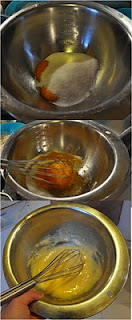
The next step is to add 2/3 cup of sugar to the 3 egg yolks and whisk it together. At first this seems unlikely, but with a little perseverence and elbow grease (you might also consider using a fork) it becomes a thick, pale, creamy concoction.

Then you mix the chocolate, the nuts, and the prunes into the egg yolks, and mix it all together into a nice velvety chocolate mix.


Now, beat the egg whites into stiff peaks, and then fold them into the chocolate mix. You'll hear a lot of "snap-crackle-pop" as the bubbles of air in the whites explode upon immersion into the chocolate. Just be as gentle as possible while being thorough about mixing them (oxymoron, I know). Pour everything into the cake pan, and bake for 28-32 minutes. The cake will puff and pull away from the sides of the cake pan. A knife blade should come out slightly streaky.

Take the cake out of the oven and let the cake rest for 10 minutes before unmolding it from the pan. Our cooling rack has unfortunately wide spaces between the wires, which makes my cake look funny:

Once it's cooled completely, you can make up the glaze and glaze the cake. Melt 3 oz of chocolate (~90 g) with 3 Tbsp of butter (a little less than 1/4 of a package), and mix it together with 3 Tbsp of powdered sugar. Pour this over the cake, and spread it so that it makes an even glaze. Personally, I always screw this step up. But The nice thing about this is that after about 30-40 minutes, the glaze cools to a frosting-ish consistency, so you can "frost" the cake with cool designs and nobody will be the wiser.

Then you go back and clean the kitchen so that your boyfriend doesn't kill you :-) And also so that you have room to make dinner for three hungry cats and yourself.