It's no secret that I love thrift stores. Even in the US, my preferred supplier of things like coats and hats were secondhand, though that was mostly because I like men's hat--at least, unusually-styled hats--and thrift stores were the only places I could find such things at prices that I liked. In Maastricht, Tuesday nights would find me more often than not at Mattie's Kringloopwinkel, where I procured my furniture. Nijmegen, though, hid her thrift stores well, and it took me a while before I learned enough about the city to find all of them:
By far my favorite is the Ideële Kringloopwinkel. It's well-hidden, but it has by far the most interesting--and most buyable--stuff. I've bought something almost every time I've gone there, which says a lot considering how far out of the way it is from everything, and how small the shop is. Despite its small size, it boasts a good selection of stuff, and I've managed to find such diverse objects as laundry baskets (matching style and color with the one we already had, even!), a wine rack, a trenchcoat--and all at reasonable secondhand prices, too. You cannot pay with a PIN pass, alas, so make sure you have cash before you walk in.
Het Goed is a chain of thrift stores, and as such it has by far the most stuff and the biggest selection, arranged across four floors. It is actually pretty spacious, unlike most thrift stores, and you can look around and poke into stuff without incurring the wrath of a grumbly clerk. I like to buy books there--they have an ever-changing selection of English-language books, and most of them are gently-used. I usually pick up small household items in Het Goed, things like baskets or spray bottles. They have an impressive selection of electronics, which is how we came by our speakers. However, Het Goed almost never has anything truly wonderful, which is why, as useful as it is, it's not my favorite.
Amaretto is a little tiny shop that bills itself as an antique store, though in reality it's another thrift shop. It's where I purchased our Galileo thermometer, and I'm still considering buying a ye-olde otoscope kit that's been sitting in a display case for ages, as a gift for Karel. However, the shop is impossibly tiny, and incredibly cramped--it's a bit evocative of Olivander's Wand Shop, wehere every last nook and cranny is occupied by something or other, to the point where the proprietor has taken to sitting in a chair by the window rather than at the cash register so he can read his newspaper. The prices are a bit higher than you'd expect, but on the other hand, many of the goods are one-of-a-kind, or at least very difficult to come by anywhere else in the city.
The Habbekrats is better known as "the place you get your fireworks from", as every December half the store is cleared of all its stuff to make room for a massive display of explosive projectiles. They have a bit of everything--I bought my binoculars there, a massive set of 8 x 50 lenses with coated glass, and of a surprisingly high quality glass, too. Most of the time, the stuff there is crap, but every now and then you find something good. We bought our coffee table there--their delivery policy is similar to that of Het Goed, in that you arrange with the store owner when you can be there, and he shows up within those times with a truck and your furniture. Unlike most kringloopwinkels, the Habbekrats does not carry clothing, although just across the street is a consignment shop in case you really need a clothing fix.
It's important to remember this cardinal rule if you're thrifting: if you don't absolutely love it, don't buy it. You don't save money if you spend it on something you'll never use/never wear. Happy hunting!
Showing posts with label shopping. Show all posts
Showing posts with label shopping. Show all posts
Saturday, December 10, 2011

Saturday, October 22, 2011
Lady Bags
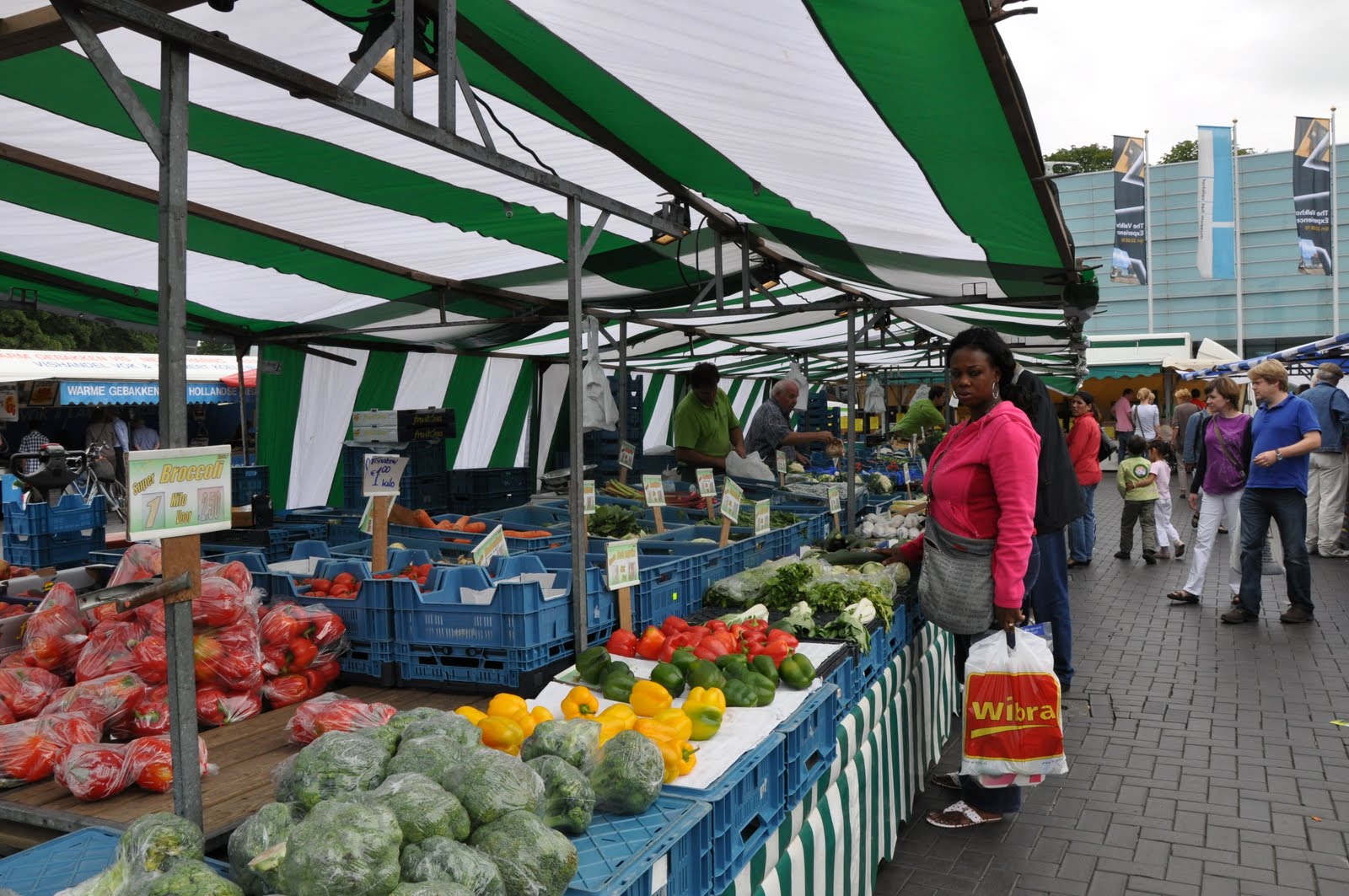
Nijmegen and the surrounding villages have a collective population of about 250,000 people, and on Saturdays, it seems like every one of them is pouring into the markt. They buy shoes, clothes, knick-knacks, outdoor gear, books, etc. And sometimes--just sometimes--you might even see a woman buy a purse.
There are a plethora of cheap and not-so-cheap purse sellers, and a decent number of high-end purse-and-luggage stores (sorry, Wenneke's doesn't count). Given the sheer number of €5-purses to be found, one could reasonably be expected to wonder how the high-end stores stay in business. The answer: they're actually in cahoots with each other.
Most women will naturally gravitate towards the less expensive items, because they're Dutch and they're women (we're like that). With purses, though, you definitely get what you pay for, up to a certain price (€200, by my reckoning), and the trick is to get a bag that will last long enough to justify the price, while still spending as little as possible. But at some point, you just get sick and tired of the handles breaking, zippers getting stuck, clasps no longer clasping, and, in some of the really cheap bags, you can even wear a hole right through the bottom.
It is at this point that the woman decides that she IS GOING TO GET A NICE BAG, no matter how much it costs, one that doesn't fall apart and one that will last the ages. And so she visits a high-end shop, looks around nervously, and then, after several weeks of agonizing choosing, makes a decision. She will have put more thought into this one bag than she has for all of her previous bags put together. It may even frighten her when she makes the purchase. But she makes it anyway, because it will be the last purse she has to buy for a long time.
At least, that's how I envision it, because there really is no other explanation for how the posh stores stay in business. And that's certainly what I was thinking when I bought mine.
Tuesday, September 27, 2011
The Pen 15 Club

This probably dates me in a way that ought to be embarrassing, but when I was a little kid, the height of scandal and humor was to ask someone if they wanted to be a member of the "Pen 15 Club". It didn't take much imagination, even at six years old, to realize that if you write "Pen 15" really close together, it's quite a dirty word (to a six-year-old, anyway) and therefore it was hilarious to write it on your hand in permament marker. Of course, merely being six years old and having a permanent marker was enough to make you cool.
I have a weakness for good pens, especially rollerball pens with a point of 0.5 mm or less. Although I do a lot of my writing on a keyboard, my (paying) job requires me to keep a lab notebook. And because I remain too poor for an iPad, pen and ink and dead trees will have to do for me. There aren't that many rules for keeping a lab journal, but just about everybody everywhere insists on writing in ink.
In any event, one of the things that has plagued me to distraction ever since I moved here is that it's hard to find a decent gel ink pen anywhere. Why a gel ink pen? Because the ink stays put, come hell or high water--and high water is a very real possibility in a lab.
Although corporations have access to the likes of Staples, the little people are reliant on the office supply sections of department stores like the V&D or the HEMA. For the most part, their selections are pretty good, although the Dutch preference for a two- or 23-ring binder continues to flummox me. Cheap ballpoints are sold by the box, while sligtly-nicer-but-still-cheap gel pens are sold individually.
My main issue with the pens available in this country, though, is not that they are expensive, or even their relative unavailability. As a non-hooking lefty, any pen I use will stuck when I push the point along, but the problem seems worse here than it did in the States. I hate writing with a ballpoint--the ink never flows nicely out of those, even for righties. Furthermore, the ink that comes from a fat point (0.7 mm) never dries before my hand comes along and smears it. And wouldn't you know--gel ink pens are only sold with 0.7 mm points.
Tuesday, August 23, 2011
Screwing

A few weeks ago, I saw a video on YouTube for something that, for better or worse, could be called "hair screws". I immediately wanted to try them, because any product that can hold my hair in place--never mind in an updo, which is my preferred method of wearing my hair, since long ponytails are also annoying to deal with--is worth its weight in gold. See, my hair is straight, thin, and smooth--meaning that any method of holding it in place is bound to slip and fail at some point. When I was eight or nine, I persuaded my mom to let me get a perm, which promptly fell out after a week. Hair products that purport to hold a style in place for hours at a time literally cannot get a grip on my hair. So hair screws, that promised not to fall out and hold my hair without slipping? Too good to be true.
It took me a while to hunt them down--they were hidden on the bottom shelf, behind some bobby pins, at the local Etos (slightly-more-upscale version of the Kruidvat), and they came in only one color, which was dark brown. Fine by me--my hair has only gotten lighter over the years, apparently--but I would have gotten the "blonde" color, because I was that curious, and since it gets buried in your hair anyway, I don't think anybody would have noticed.
I've since found that they don't work that well if my hair is dry--it really has to be damp for the pins to get the traction to hold them in place. If I put my hair up after I wash it, it stays in place for the rest of the day--the rest of the day. Revelation and glory! Most Dutch women either have short hair, or wear it long, so going out with a bun (or a chignon, in my case) seems to be a token of or extreme snobbiness. Frankly, my dear, I don't give a damn: fiddling with my hair only once--at most, twice--a day is a convenience I will always cherish.
Of course, that means I'll need something else to piddle around with when I have a writer's block. Tune in later to see what I've found...
Tuesday, April 19, 2011
Plastic creep

On the list of "You know you're going Dutch when" includes such things as: waiting for a parking space--for your bike, cruising Marktplaats.nl for furniture, and wearing leggings-and-boots (ladies) or blazer-and-t-shirt (gents). Women, in particular, will carry purses that can outfit an entire army platoon, and sometimes does--Karel tells me that, on more than one occasion, when he was little, his mother would pull out a sweater from her purse for him.
But perhaps one of the definitive "You know you're going Dutch" signs is having an Albert Heijn card. As one of the most ubiquitous supermarkets, what makes the AH (pronounced "ah-ha") unique in a land of penny-pinchers is that it's actually not the cheapest, and the generic supermarket brand of stuff is a cut more expensive than the truly generic stuff. Actually, the last is not unique to the AH, and I've noticed the same at the C1000. The difference is that you don't mind it at the AH, but you do mind at the C1000, and I think it's because the packaging of C1000 stuff looks so tacky cheap, and if you check the price, you expect it to be lower than it is.
One of the first things integrated expats will have learned is that getting a Bonus Card will save you lots on your groceries. This little piece of plastic lets you take full advantage of sales, and get the lowest prices on items marked with a "BONUS" sign. Whether or not it's actually the lowest price you can find is debatable, and framed by the greater question of whether it's worth the twenty-minute bike ride in the other direction to find out.
About three years into my stay here, the Bonus Card was joined by my Ringfoto card, where I'd bought my DSLR. 1% cash back made sense at the time: I'd spent about €1500 over one month for all the stuff associated with a DLSR, and that netted me a set of free prints. Since then, it's not seen much action at all.
Then my boyfriend went on a survivalist kick and procured a Bever Zwerfsport card: Bever is kind of like REI in the States, selling fashionably styled Gore-tex--because we all know that, when you're in the middle of nowhere, pink is "in". But they also carry a lot of really handy things, like water bottles and (good) flashlights, carabiners, heavy-duty walking shoes, climbing gear, and Sporks (handy for lunch). Why do I have it, if he's the survivalist? Because he never remembers his :-D
We didn't mind: Outdoor gear and photo prints aren't things we get regularly, and the time between purchases is long enough to allow us to forget that we'd signed away our annonymity for 25% off retail price. We don't buy from those stores often enough to be considered "valued customers". If it'd just stopped there, we would have been golden.
But I draw the line at Kruidvat. Kruidvat is sort of like a cross between a dollar store and a CVS--it's always fun to browse the crap racks in the back of the store, because every now and then something nice will pop up. It's where I buy things like shampoo, so I go there pretty frequently, the better to stock up on name brands at generic prices. Imagine my surprise, then, when the cashier did not ring up the price on the sign, but something in between the advertised price and the full price. When I pointed out this discrepancy, she merely handed me the flyer for a Kruidvat card. "Use this to get the full discount."
I'm not sure why this annoys me so much. It's not like you have to give out your bank information with anything--unlike a credit card, these are basically just bar codes that get scanned at the time of purchase. Maybe it has to do with my ego asserting itself, saying, "I'm ME, not Every Other Dutch Dude." Maybe it's because my wallet is that much heavier. Maybe it's that the Kruidvat card is so virulently red--and that's just the one side; the other side is silvered, so that it can reflect "your smile when you see how much you've saved". Because really? Who smiles at a bottle of shampoo?
Subscribe to:
Posts (Atom)