Weather in the Netherlands is never reliable, not even with weather reports. This is, in part, due to the fact that the country is miniscule, but also because the eastern part of the country, where we live, is right at the boundary between coastal and continental weather. You don't really notice the difference, until you get into a train under the auspices of golden rays of sunlight, and step out into a downpour. I've been drier getting out of the shower.
So planning vet visits is always dicey. First and foremost, of course, is finding a day when we're both free, which is hard enough. Then we have to find a day and time when the vet is available, which is even harder, since they charge an extra €20 on the weekends. But lastly, we'd like it to be not-too-hot, not-too-cold, and preferably not-raining. This latter is nearly impossible to plan for, as we usually schedule vet visits weeks in advance. And it's been COLD.
The temperature this past week has been below freezing all week. I've been wearing leggings and long johns to go running and get to work. It's been so cold that wet laundry freezes stiff in ten minutes--after fifteen, it can be used as a weapon (the upside, though, is that it smells INCREDIBLE after it dries). Not that I would know.
So walking to the vet with our Kitty Tower of Terror required a few extra considerations, on top of the usual concerns about bungee cords and figuring out to cram all three fuzzbutts into their respective carriers without having them hide in impossible places. The Tweeb, in particular , is all skin and bone and and thin fur, so she got a hot water bottle in hers(much to our regret, as she was plenty comfortable enough to belt out her own operetta of howls and yowls). The entire KiTT was wrapped in one of our fleece throw blankets, which we thought would convey the added benefit of screening the kitties from seeing the enormity of the whole wide world. Alas, all it did was keep us from smelling Noodle's stress-turd until we go to the vet's. By then, Karel was quite frazzled--and I wouldn't have put a stress-turd past him.
Like Shadow, I bear these trips to the vet with an equanimity that's not quite grace--they're part and parcel of having fuzzbutts, so it must be put up with. Still, even though I'd prepared for it and checked my balances ahead of time, getting socked with an €[ungodly number] vet bill is something that you never really get used to, no matter which side of the Atlantic you're on.
Tuesday, February 7, 2012
Saturday, February 4, 2012
Light reading
We have one credit card between the two of us, and most of its use goes towards ordering books off Amazon (the UK site). And one of the things that we are now in possession of is Dick's Encyclopedia of Practical Receipts and Processes: or, How They Did It in the 1870s. Behind the formidable title lies a formidable book: in it are directions, "in plain language", for how to make cosmetics, soap, and patent medicines. How to preserve meat, purify metals, bleach anything, dissolve bones, preserve wood, polish Alabaster. In short, how to do everything and anything, without everything and anything that we have today.
It's a fascinating read, actually, particularly the section on patent medicines: the recipes range from hopelessly useless to if-this-doesn't-kill-you-then-you'll-probably-survive-the-disease. Recipes call for orange oil, rhubarb root, fennel, molasses...and things like nitric acid, belladonna, and laudenum. "Cures" for things like whooping cough consisted of pulverizing roasted onions and making a poultice wrap and setting it on your throat (alas, this arrived after my bout with Bordatella pertussis, so I did not get a chance to try it--purely in the interest of proving that such sh*t doesn't work). Preserving milk--keeping it "sweet"--meant boiling it with baking soda.
Supposedly, it is a very "practical" guide, assuming that you can get things like hydrochloric acid, sulfuric acid, nitric acid, saltpetre, etc. And that's to say nothing of some of the more fantastic concoctions, such as "essence of morphia" (morphine), opium, and cocaine (and people have issues with legalizing marijuana!). Try getting your hands on things like brimstone, cyanide, and benzene--the last, incidentally, was a cure for head lice (and the child who was thus afflicted, apparently)--these days. The scary thing, then, is not that all of these things were used. It's that they were apparently readily available enough that a "collection of popular and domestic receipts" thought nothing of including them.
There are two things I have concluded from perusing Dick's. The first is that the days of "all natural" things are an illusion we've made for ourselves. We tell ourselves that things were better off in the days before additives and preservatives with names I can't spell and can barely pronounce, but do you REALLY think using hydrochloric acid to preserve your meat is that much better? Anti-vaccine whackos (who really should be charged with manslaughter by negligence) have got all of us worried about autism, but going back to the days when a mashed onion was all that stood between you and death-by-diphtheria isn't exactly my idea of paradise. People in the 1870s would probably kill to have what we do, today: reasonably safe and effective cleaners (for all that I mislike using Purple Stuff, it is a good deal safer than cyanide), refrigeration for meat and dairy products, and medicines that actually work. "All natural" is overrated, and is the kind of thing that only people who've never actually had to live without can wish for.
The second is that people who wish for less government regulation really have no idea what they're wishing for. The free market in 1870 was probably a lot more capitalist than it is today, but if you wanted to sue your doctor for giving your kid a deadly dose of "chlorodyne" (laudenum and chloroform), you'd be hard up to try. When you read through the lists of recommended "receipts and processes", it's a miracle that anybody lived long enough to reproduce, and had enough functional internal organs to do so.
Friday, February 3, 2012
Schooled
Karel, for all his wonderful qualities, remains a steadfast luddite in many ways. It was only very recently, for instance, that I was able to persuade him to get an OV Chip card (one of the annonymous ones) and introduce him to the wonderful swipe-and-beep of the OV Chip reader. Say what you will about the loss of personal connectivity between a bus driver and his passenger--when it's colder than balls out, any moment extra spent waiting outside is a moment too long.
Aside: It came to my attention last week that some riders are saying that the OV system is too complicated. That it should be easier--you should just be able to get on and get off the bus without remembering to uitchecken. I get that the loss of €4 for forgetting to check out might be a hardship. But you can only do that so many times before you start remembering. Hell, if Karel can remember to check out, the rest of the world has no excuse.
Lately, though, it's come to his attention that social media might not be the pure evil that the likes of Dr. Phil make it out to be. I'm on Facebook (not under Jules, but under my real name), and I check it regularly to see what's going on in the world, to find out what my friends are reading, and in general just to keep up with people's lives. It's a nice way to keep in touch with people who I don't see frequently. It's certainly no substitute for one-on-one time, but it can keep the embers hot until everybody can get together for the marshmallow roast.
So one of these days, he might just start appearing on Facebook. And then you can ask him whether everything I write here is true, or complete bullsh*t.
Sunday, January 29, 2012
Moving along
After much consideration, I've decided to formally move into the world of freelance work. I've been getting "ithcy feet" for a while, actually--it's what happens when your job can be done by a few trained monkeys, until something goes disastrously wrong (which happens more often than my boss would think, apparently). And also, the financial situtation in the sciences has only gotten worse, and as of March I will be officially unemployed again.
However, until that happens, I will be using the time to set up my own company, and Karel will be delighting in that holy-of-all-holies, the pass to the Makro (Dutch equivalent of a Costco) which I would receive automatically as a small business owner. And of course, drumming up business, post-business. There's a vet visit somewhere in there, too--blood panels and yearly checkups.
So basically, this is a shameless plug for photography gigs. If you or someone you know of is hosting a gathering where they want pics; or if you want photos of something or somewhere or someone, shoot me an email. My sample pics are all over the blog, so if you like the work that I've done and would like me to do it for you, let me know.
Saturday, January 28, 2012
Friday Night Light
I'm not an especially literary person. My favorite books tend to be nonfiction, and I'm having a helluva time slogging through Murakami's 1Q84. The fault might be mine--I tend not to like overly "literary" literature, preferring books that just tell a story and tell it well (Justin Cronin's The Passage is a great one). I am therefore, despite my prolific blogging habits, less than inclined to try my hand at poetry.
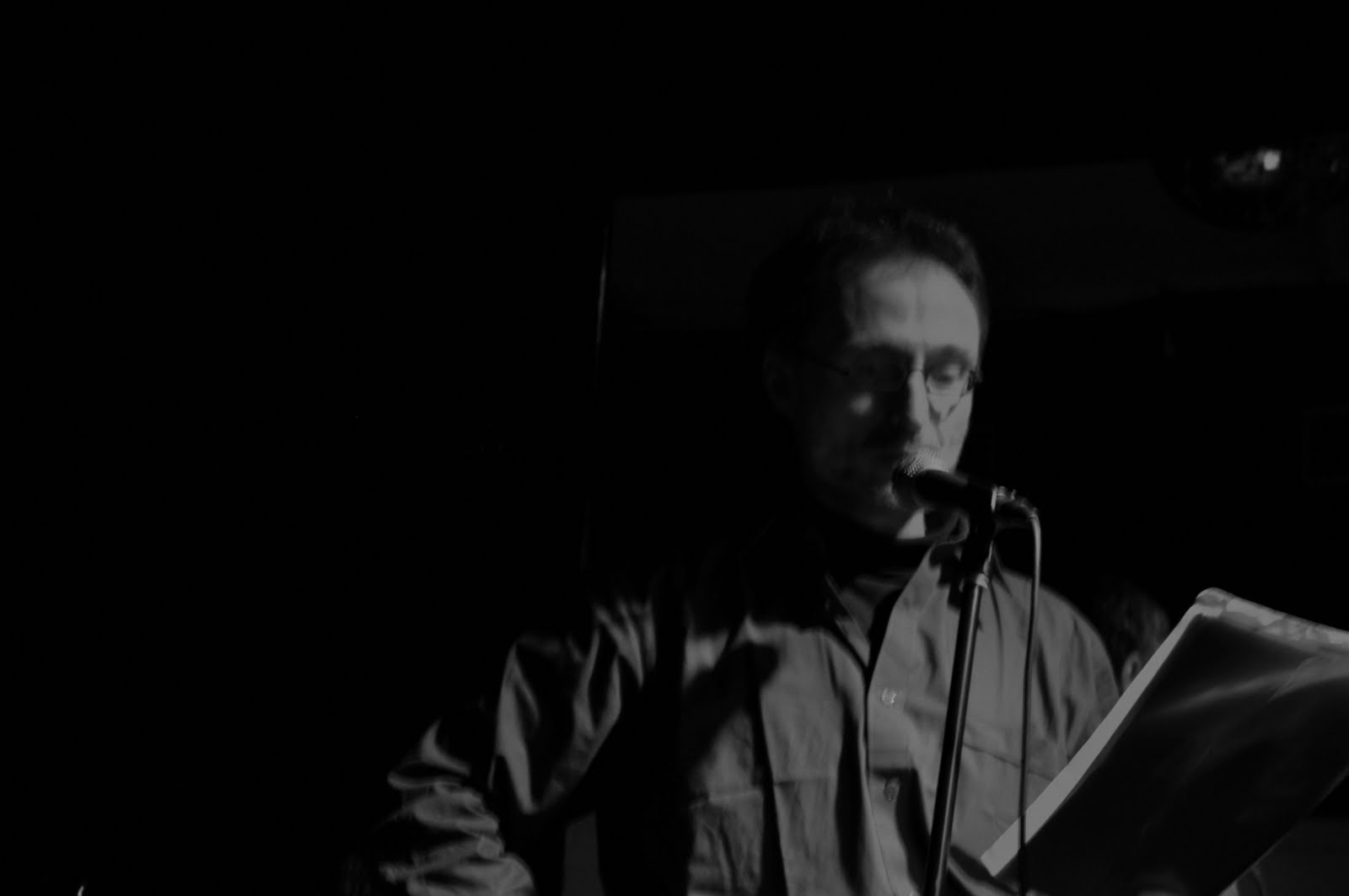
Doesn't mean I don't enjoy poetry, though. The rhythm and flow of words lulls you into a trance and you connect with the material on an emotional level that poets spend years trying to capture, and English teachers spend years trying to teach. So when our dichter friend invited us to come see him perform his poetry at Nijmegen's Dichternacht, I couldn't wait to go. Plus, my Dutch has finally gotten to the point where I could probably understand most of the poets, provided that nobody mumbled. And as a bonus, I could try my hand at shooting people. With my camera, that is.
It was an interesting night, full of explosive, amusing, interesting readings. I did not understand most of it--too full of Dutch-isms, I guess--but you could get the gist of the poems from the tone: meditations on the seasons, life, love, and medications, and wordplay. Something I never could understand about poetry readings, though, is the need to perform the piece. There were a few poems that needed it, but by and large I've always felt that a poem should speak for itself--if you need to gussy it up with shouting or whispers, to sing a part of it, or to read it the way Kenneth Brannagh reads Shakespeare, in order to get your point across, mayhaps you ought to choose better words, or use better punctuation. That being said, there were a few poems that were improved by foot-stomping and added rhythms, but it should be noted that the guy was a musician before he became a poet, and therefore knew what he was doing.
The Dutch are keen to preserve their language and enjoy being artsy, so the Cafe Otis was packed with people. True to the Dutch fashion, there weren't enough seats for everyone--oh hell, there were pratcially no seats for anyone--and the bar consisted of a single long shelf of multi-colored bottles. Never mind that the Dutch language isn't really suited for poetry--the hard "g" breaks up the ebbs that the rest of the words have lulled you into. It's like having a random cymbal crashes during Smetana's Die Moldau. Working that particular phoneme into a poem so that it sounds organic is, I would imagine, the challenge of Dutch poetry.
The other aspect about poetry nights that I find particularly irksome, as a photographer, is the god-awful lighting. I knew, going in, that it would be low lighting--these sorts of things always take place in the gloom of semi-darkness. I hadn't expected it to take place with red lights, though (reddish, not pure red, but still annoying as bugger-all). Which is why today's posts are black-and-white--I didn't think human-shaped tomatoes would be much appreciated.
Doesn't mean I don't enjoy poetry, though. The rhythm and flow of words lulls you into a trance and you connect with the material on an emotional level that poets spend years trying to capture, and English teachers spend years trying to teach. So when our dichter friend invited us to come see him perform his poetry at Nijmegen's Dichternacht, I couldn't wait to go. Plus, my Dutch has finally gotten to the point where I could probably understand most of the poets, provided that nobody mumbled. And as a bonus, I could try my hand at shooting people. With my camera, that is.
It was an interesting night, full of explosive, amusing, interesting readings. I did not understand most of it--too full of Dutch-isms, I guess--but you could get the gist of the poems from the tone: meditations on the seasons, life, love, and medications, and wordplay. Something I never could understand about poetry readings, though, is the need to perform the piece. There were a few poems that needed it, but by and large I've always felt that a poem should speak for itself--if you need to gussy it up with shouting or whispers, to sing a part of it, or to read it the way Kenneth Brannagh reads Shakespeare, in order to get your point across, mayhaps you ought to choose better words, or use better punctuation. That being said, there were a few poems that were improved by foot-stomping and added rhythms, but it should be noted that the guy was a musician before he became a poet, and therefore knew what he was doing.
The Dutch are keen to preserve their language and enjoy being artsy, so the Cafe Otis was packed with people. True to the Dutch fashion, there weren't enough seats for everyone--oh hell, there were pratcially no seats for anyone--and the bar consisted of a single long shelf of multi-colored bottles. Never mind that the Dutch language isn't really suited for poetry--the hard "g" breaks up the ebbs that the rest of the words have lulled you into. It's like having a random cymbal crashes during Smetana's Die Moldau. Working that particular phoneme into a poem so that it sounds organic is, I would imagine, the challenge of Dutch poetry.
Friday, January 27, 2012
Pot and Kettle
Visitors to our humble abode will notice two things: 1) that we have a lot of candles and things that operate with an open flame, and 2) that our cats are allowed to do just about anything, under the theory that, were we not home, they'd do it anyway. How the two have managed to coexist without creating a towering inferno is one of those little miracles of life.
But despite our propensity for fire, we do have an electric kettle. An electric kettle is basically a kettle whose sole function is to boil water. You fill it up to whatever amount you need (usually around 1 L for us), push a button, and about 2 minutes later, you have boiling hot water you can use for tea, ramen noodles, cooking, etc. It takes about 5 minutes to boil a full kettle (1.7 L), but ours is one of the lower-end models. The kettle turns itself off when it's finished. It's been such an integral part of my life that, like my sneakers, I've simply not thought to blog about them. But as I do follow a few American blogs, it struck me that these must not be espeically popular in the US, whereas they are incredibly popular in the Netherlands. I don't know of a single Dutch home without one, and I'd even go so far as to say that, across the entirety of Europe, every home has at least one electric kettle. Even in my student house in Maastricht, my suitemates kept an electric kettle in the kitchen, free for anybody to use.
I'm guessing that there are some not-entirely-unjustified concerns about safety. Water and electricity have always been an uncomfortable mix for most people. However, I would say without hesitation that, given the placement of our microwave, and the fiddliness of our gas stove, that the electric kettle is one of our safer appliances. Right next to the coffee machine, literally, where ours sits. To be quite honest, it does make some pretty scary sounds while it's bringing water to the boil, but I've never seen one, no matter how old, go on the fritz.
Or maybe it's that there's no way to sexy-up an electric kettle. You can give it whatever shape you want, make it out of titanium, add a filter, brag about how compact it is, but at the end of the day, you have to make it so that you push a button and water is boiled. It's so simple, compared to a space-age microwave or a state-of-the-art dishwasher, that I could imagine that it'd be hard to market: "It boils water! Really fast!" "So?"
Hm. That is kind of hard to sell. I guess it's one of those things you have to experience first, before you realize what an awesome thing it is.
Wednesday, January 25, 2012
Test Tube Tomatoes
Those of you who read science journals on a regular basis have probably seen this study, which demonstrates that microRNAs from your food can end up in your bloodstream, and that miRNAs from your food can affect the way you process fats (and presumably other things, but LDLs were what the paper looked at). It's a long, highly technical paper (even for me) and like any good science paper, it raises more questions than it answers: can miRNAs from animals do the same thing? How much plant material does one have to ingest before miRNAs show up in your blood? I don't work with miRNA, so I don't have the expertise to say whether their conclusions were justified. But it is, literally, food for thought.
One thing the paper did not mention was genetically modified organisms. Yet, somehow, a writer decided the two must be linked, and consequently wrote up this non sequitur. Now, obviously, GMOs have miRNAs that can affect your body. SO DOES EVERY OTHER KIND OF FOOD. But apparently the threat of GMOs is so great that this bit of science, as new as it is, should be considered as proof that GMOs are dangerous.
Now, I maintain that GMOs are no different from your average, run-of-the-mill end result of selective breeding, and that given all of the weird things we do with food, a couple of new proteins is the least of our worries. It's strange, isn't it, that foodies worship Ferrian Adria and the things he does with food--vaporizing a tomato, things like that. Yet the moment someone says they modified something--genetically or otherwise (as if nature gives a sh*t where the gene comes from)--everybody freaks out about how dangerous it is and that this is "unknown territory".
But anyway, that's just me. The fact is that it doesn't really matter what I think--the EU forbids the sale of GMOs to consumers, and the use of such products in our consumer goods. And while I'm not entirely pro-GMO (I think the technology could use a lot more oversight in how it's implemented), I'm not rabidly against it. Like I said, we do weird things to food, and treat it as a gourmet item. Foie gras is the end result of a disease we induce in geese--and yet it's only available at the most upscale restaurants.
There is one thing worse than not enough funding for the sciences, and that is scaremongering by uneducated journalists with respect to the conclusions that can be drawn by the research they are writing about. It would have been fair to say that the findings of the paper mean that we will have to evaluate our relationship with food more carefully. It would even have been fair to speculate that Monsanto and other Big Agriculture corporations might have to re-evaluate their claims of total safety for GMOs. But to conclude that the research means that miRNAs in GMOs are different from that of regular food (which would not be the case--if they are different it is because they are introduced, and as far as I know nobody has done this with plants) and are therefore somehow more dangerous is extrapolating a step too far. Scaring people with the idea that Big Agriculture is somehow going to kill you with their mutant tomatoes is just plain irresponsible.
Subscribe to:
Posts (Atom)