Showing posts with label DIY. Show all posts

Monday, October 17, 2011

All Hung Up


Our washer gave us a bit of a scare earlier this year, when it spontaneously decided it wasn't going to drain the wash water any more. After it got tweaked by the mechanic, it drained the washer--but then it started forgetting to go to the spin cycle unless we reminded it. In spite of these quirks, it's a good little washer, and Karel and I haven't seriously considered replacing it.

Nor have we seriously considered getting a dryer. First of all, there simply isn't any room in our apartment for one. But secondly, it is amazing how much laundry can be accommodated on two drying racks, two indoor clotheslines, and the balony rail. Since we "only" do up to five loads a week (like I said, a "good little washer")--what with sheets, towels, and all the rags that get used in cleaning the place--everything fits and everything gets dry within a day or two.

The downside, of course, is that we're almost constantly doing laundry. This is especially an issue when I HATE DOING LAUNDRY. It's not the washing or the hanging or even the taking down--it's the specific task of sorting and making sure my socks don't end up in his bin. Yes, we steal each other's socks anyway, but it's the principle of the matter that counts. Not even craptastic TV like Hart tegen Hard can ease the pain.

And the weirdest thing is, it doesn't even take all that long to do. Fifteen minutes, twenty if I'm having a hard time scrounging up stray hangers--tops. It's over so quickly that I swear I spend more time resisting the laundry than doing it. Kinda like I am now.

So, Internet, what are the jobs you have to do all the time, that shouldn't bother you as much as it does?

Saturday, September 10, 2011

Wrenching

Photobucket
The Bike Shop in Philadelphia knew me as a regular. Not because I went and bought so many bikes, but because I often stopped by to pump up my tires to the recommended 80 lbs psi, and it was nice to ask them about stupid little clicks and squeals that my bike, bouncing over the potholes, would inevitably acquire. Plus they were always really nice and if the squeak only involved tightening a bolt or putting a smidge of grease on it, they didn't charge me for it. If it ever did need more extensive repairs, they'd always tell me how much it'd cost beforehand. I eventually ended up buying a book on how to "wrench" bikes, as bike maintenance is so presumptuously called by the author, and doing the basic maintenance myself (I don't remember the name of the book, alas, only that it was yellow and the guy on the cover was not Langley).

In the Netherlands, though, if you set foot in a bike shop, you're going to be out at least €10--that's the minimum that places charge for a repair, no matter how small. Dutch name-brand bikes (Gazelle in particular, though Batavus is also popular) are built like tanks, and in combination with the generally-well-maintained roads, they can be ridden until the paint falls off and the tread is completely worn away--and they'll still work. If for some reason you have to drop by a repair shop, it'll be the last time they'll ever see you for a few years. I've had more flats in six months in Philadelphia than I've had in my entire time in the Netherlands--and none at all with my current bike, which is now entering the second year of my ownership. I'll grant you that at first I didn't know how to change a flat properly, but even when I did, Philly streets apparently eat tires for breakfast. Flat tires are the one repair that, for my sanity, I'll always get done by a pro.

Bike shops are everywhere in the Netherlands, and most of them are reasonably priced for their repairs, although most of them also make you wait a few days or maybe a week or two to get your bike back. If it's a fast repair you need, then take it to the bike shops that are associated with major train stations--they'll get you sorted out in a jiffy. Unlike regular shops, those bike shops are required to be open as long as the trains are running, and they've never made me wait longer than the next day to pick up my bike. Of course, they also charge a premium for speedy service, but being without a bike in the Netherlands is like being without a hand, and in my mind, well worth the €20 fee.

The other major blow to my cycling self-sufficiency in the Netherlands is the fact that all of the bikes I've ever owned (I'm on my fourth, which I have yet to ride to the point of breakage--which is why you never spend less than €200 on a bike) have a gear cover. Most bikes have their gears encased in a plastic shell--a necessity to keep the chains from rotting out from under you in a rainy climate, when most people store their bikes outdoors. The shells are not one seamless lump of plastic, formed over the gears. They just look that way--and for that reason, their dissection is best left to the experts. I love being able to ride a bike without grease stains too much to randomly tinker with that.

Still, the Metro reported a while ago that the number of bike mechanics was steadily dropping, saying that the old-timers were dying or retiring and the young blood just wasn't there--not enough interest. I find that hard to believe, especially given the demand in the Netherlands. Sure, it may not be difficult to do, but there's nothing like three-day-old grease stains embedded in your skin to make you reconsider reaching for your wrench. Unless you're like me, and like that sort of stuff.

Tuesday, May 24, 2011

Eighth grade all over again


Every year or so I take a picture of our apartment, as a way to document what happens to it as we remodel, redecorate, and upgrade the furnishings. It's kind of fascinating to watch the place change over the years, as we've settled in and put our own signatures on this place.

Part of the reason why it's taken so long is because we're exceedingly fussy about what we want, and part of the reason for being so fussy is because we don't have much space (or money) to keep trying. The other reason is because our local Gamma (scaled down Home Depot) is irritatingly far away and expeditions to it need to be planned well in advance.

These past couple weeks have taken me back to my middle school years, as we learned how to sew, use a jigsaw, pour molten aluminum, and make pizza, while trying not to looke like we cared (because it wouldn't be cool). Drafting a design, doing the math, cutting the pieces, figuring out how to put it all together, praying the math works out...and when it does, and when you see the final product, life is beautiful. Still.

I'm not delusional enough to think that I could ever be a master craftswoman--our curtains stay up and my skirts stay on and the shelves are standing, but I don't have any Fingerspitzengefühl for these things. But it does make me wonder whether we'll ever go back to those days when people who worked with their hands were respected for the skills they had, rather than disparaged for the knowledge they didn't.

Wednesday, May 4, 2011

When Life Hands You Basil


It's hard to find a perfect lemonade on either side of the Atlantic. Here in the Netherlands, the Dutch (and Europeans in general) don't believe in ice. In the US, you'll get lemon-flavored sugar water instead of lemonade that puts you into a hyperglycemic coma before you've finished a glass. The obvious solution--to make your own--is hampered by our willingness to believe that we could possibly use that much sugar in our lemonade.

Fortunately, I've been baking for a long enough time to get used to the idea of "cups" when it comes to measuring out sugar. And fortunately, you don't actually need whole entire cups to make a liter of lemonade. Unfortunately, ever since I introduced Karel to the concept of basil-flavored lemonade, he's had an unsatiable hankering for more, and every summer, he follows me around the house whining for more--er, no wait, that's Noodle. But he does make a point of keeping me well-stocked with lemons.

It's not that difficult to make [herb-of-choice]-flavored lemonade, so I'm not sure why he insists that my lemonade is somehow "different". If you were to ask me, I think it comes down to the fact that I don't use a citrus-juicer, or a fork, to juice the lemons. No matter how careful you are with those instruments, it seems that you always scrape a bit of the pith into the juice, and that gives the lemonade a bitter edge. I use a tea spoon to extract the juice.

Basil, dragon, and mint all go great with lemon, but the trick is to cut it up very finely and work the juices into the sugar, first. Then you dissolve the sugar into the lemon juice, plants and all (the plants will not dissolve), and keep on brusing the leaves and stirring. I've never had the patience to wait for the sugar to dissolve entirely, and usually end up washing the whole thing into the pitcher, and finishing up the stir-job there. Straining the leaves is optional--if you leave them in, obviously the flavors will continue to infuse--and I leave them in on the principle of working in more fiber ;-)

It really is a lovely drink, but be forewarned: you may never drink lemon-lemonade again, and if you have a significant other, you may never hear the end of this.

Saturday, March 5, 2011

The Dairy Aisle

I've finally been able to restart a little every-eight-to-ten-day ritual that I haven't been able to do for the past year: making my own yogurt. The process is pretty simple: heat milk to almost-boiling, let it cool to slightly-hot, add some pre-made culture (i.e., yogurt at the bottom of the tub you've just finished eating), and let it sit under a blanket for 4-8 hours. You can strain it afterwards if a thicker yogurt is your cup of tea. The directions given here are pretty good and specify exact amounts and temperatures, if you want to try it. The key is to start with a yogurt you already like--I'm partial to the Albert Heijn's plain organic yogurt, but the Greek and/or Turkish yogurts are also pretty good.

The best part about making your own yogurt is that all you need is a liter of milk every now and then. This makes going to the supermarket much less confusing, given how many different kinds of dairy products inhabit the average Dutch supermarket. You have milk, butter, cream, creme fraiche, sour cream, yogurt, vla, karnemelk, and kwark--and the magere versions of the last two.

There are several different kinds of yogurt to be had in the Netherlands, and none of them are the same as kwark, which is actually a kind of cheese, although it doesn't always contain rennet. You have your Yakult, which is supposedly good for the digestive system, although exactly how it's supposed to be better for you than normal yogurt is beyond me. Then there are the yogurts that are sold in milk cartons as yogurt drinks. These are slightly more watery than the yogurt you'd eat for breakfast, which is sold in tubs. Everything is made from whole milk (4% fat) unless otherwise specified--Greek yogurt, in addition to being made from whole milk, is also strained so that it's thicker. Turkish yogurt is not only made with whole milk and strained, it also has added cream.

Then you have karnemelk, which is actually buttermilk. Traditionally, buttermilk is the fermented leftovers from making butter, but most of the buttermilk you'll find in stores are made with an innoculation of bacteria, same as with yogurt. I use this to make muffins, buttermilk biscuits, and pancakes--you don't really taste the sourness, but the acid reacts with baking powder to make an incredibly fluffy and light baked good.

Vla is a thin custard/thick pudding, served as a dessert. In the words of our friend Allard, who first explained vla to me, "It gets into all of the little empty nooks and crannies in your stomach and fills it up." It is the perpetual butt of all the flessenlikker jokes, as it was once sold in bottles and had to be scraped out. It's not bad...which is the best thing I can say for it. One of these days I'll put up a recipe for pudding, which is infinitely better...

Creme fraiche is interchangeable with sour cream in most recipes, but it's pretty special in its own right, as it has much more fat, doesn't curdle when heated, and can be whipped. I don't have a lot of experience with it, but it does give a nice finish to creamy soups.

All of which adds to the confusion for expats who are used to yogurt being yogurt, and milk being milk. You have to be somewhat adventurous to be an expat, and that goes for your tastebuds as well as the rest of you. I always like trying new things.

Sunday, February 27, 2011

What I Did on Saturday


Every now and then Karel tells me that the nurses are demanding cookies asks me to bake something for the nurses in his ICU. Most of the time--that is, if I remember to pick up ingredients while grocery shopping--I'm happy to oblige him, especially if I'm planning to bake something for my lab as well.


This is what I call the "Death by Chocolate" cake. It's the kind of cake which is served in disappointingly thin slices, until you take a bite and are overwhelmed by TEH CHOCOLATE. And Armagnac. And prunes. And chocolate.

It's also a tad bit more tricky to make than most of the cookies and cakes that I typically do: the base isn't flour, but ground pecans, which you have to do yourself. You also have to flame the prunes in Armagnac (I used Southern Comfort this time--a bit less flavorful, but we didn't have Armagnac and I felt guilty opening a new bottle of cognac) before you start. And the puff of the cake comes entirely from beaten egg whites, and not any sort of baking powder. The original recipe is by Simone Beck, but the recipe I follow is from Dorie Greenspan.

The first thing you want to do is separate 3 eggs. Cold eggs are easier to separate than warm eggs, but warm egg white are easier to beat into stiff peaks. If you separate them now, the whites will have time to come to room temperature by the time you need them.

The second thing you'll want to do is preheat your oven. 375° F is a little hotter than 175° C, but because I use a larger cake pan (27 cm) than specified in the recipe, the baking time is about the same (28 minutes). If you have an 8" cake pan, then the temperature to use is 190° C.

I didn't get any pictures of the pecans before I ground them (send through a food processor and/or coffee griner), but anyway, you mix together 2/3 cup of ground nuts with 1/4 cup flour, and 1/4 tsp of salt. One package of nuts from the Albert Heijn exactly makes a 2/3 cup of ground nuts.

Then you slice-and-dice 12 prunes to the size of large raisins, and put them in a pot with 1/4 cup of water. Cook over a medium heat, stirring almost constantly, until most of the liquid is evaporated (more evaporated than in the picture).

Remove it from the heat. Take 1/4 cup of the liquor of your choice (I really do recommend Armagnac if you can get it) and pour it onto the prunes. Then set the alcohol on fire. You can do this with a long match, a special lighter, or just hold a normal match in a pair of tongs. It took a bit more coordination than I thought it would just to do that, so I didn't get a picture (plus the flames are blue, and wouldn't have shown up).

Prunes aflamed, you then melt your 200 g of chocolate and 250 g of butter and 3 Tbsp of water all together. Breaking up the chocolate and cutting up the butter wil help it melt evenly. It's always recommended that you do this in an au bain Marie, but if you know your microwave, you can just nuke it (2-3 minutes on not-full-power). You don't want it to get too hot, or else the chocolate and butter separate, but you also want it hot enough to stay warm and melty while you take care of the next step.

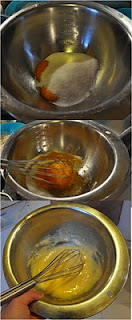
The next step is to add 2/3 cup of sugar to the 3 egg yolks and whisk it together. At first this seems unlikely, but with a little perseverence and elbow grease (you might also consider using a fork) it becomes a thick, pale, creamy concoction.

Then you mix the chocolate, the nuts, and the prunes into the egg yolks, and mix it all together into a nice velvety chocolate mix.


Now, beat the egg whites into stiff peaks, and then fold them into the chocolate mix. You'll hear a lot of "snap-crackle-pop" as the bubbles of air in the whites explode upon immersion into the chocolate. Just be as gentle as possible while being thorough about mixing them (oxymoron, I know). Pour everything into the cake pan, and bake for 28-32 minutes. The cake will puff and pull away from the sides of the cake pan. A knife blade should come out slightly streaky.

Take the cake out of the oven and let the cake rest for 10 minutes before unmolding it from the pan. Our cooling rack has unfortunately wide spaces between the wires, which makes my cake look funny:

Once it's cooled completely, you can make up the glaze and glaze the cake. Melt 3 oz of chocolate (~90 g) with 3 Tbsp of butter (a little less than 1/4 of a package), and mix it together with 3 Tbsp of powdered sugar. Pour this over the cake, and spread it so that it makes an even glaze. Personally, I always screw this step up. But The nice thing about this is that after about 30-40 minutes, the glaze cools to a frosting-ish consistency, so you can "frost" the cake with cool designs and nobody will be the wiser.

Then you go back and clean the kitchen so that your boyfriend doesn't kill you :-) And also so that you have room to make dinner for three hungry cats and yourself.